# Introduction to Ouroboros

High level overview of the Ouroboros Foundation and stated goals

<figure><img src="https://754022034-files.gitbook.io/~/files/v0/b/gitbook-x-prod.appspot.com/o/spaces%2FGBrM5XVsj4G0P2rkCSG1%2Fuploads%2FyT5owsAJS2KtSwYv2RW0%2FScreenshot%202024-02-06%20at%2017.06.32.png?alt=media&amp;token=f4c7bc93-23aa-4946-9717-eb5c34cdb3ed" alt=""><figcaption></figcaption></figure>

*The Ouroboros Foundation* is an umbrella name for an interconnected series of smart contracts which will initially be launched on the Ethereum blockchain.  At the center of this interconnected series of contracts, sits the ***$ORX*** token, which is a limited supply ERC20 token.&#x20;

**The goals of the Ouroboros Foundation are as follows:**&#x20;

* Consume as much TitanX as possible via burning, locking, and depositing into liquidity pools.
* Work synergistically with other #BuildOnTitanX projects to retain value within the ecosystem, or encourage the entry of new capital.
* Enrich the TitanX ecosystem with additional utility and functionality over time.
* Drive value toward the $ORX token via **real-yield style fee accrual, rather than inflationary/dilutionary rewards.**
* Bolster the value proposition of TitanX itself by contributing to a flourishing ecosystem of products where staying inside the ecosystem is preferable to leaving it.
* Prevent the greatest excesses of late stage bull market optimism by ensuring all users have a way to live within the TitanX ecosystem without exploitative practices taking hold. [🧛](https://emojipedia.org/vampire)


# The Ouroboros ($ORX) Token

ORX Token Details and Overview

<figure><img src="https://754022034-files.gitbook.io/~/files/v0/b/gitbook-x-prod.appspot.com/o/spaces%2FGBrM5XVsj4G0P2rkCSG1%2Fuploads%2FbjAtiloQDskmMbfwA5DU%2FOuroboros.png?alt=media&amp;token=0812625d-89a7-48cf-a1b1-418548fac3f7" alt="" width="375"><figcaption><p>ORX</p></figcaption></figure>

* **Name:** Ouroboros
* **Symbol/Ticker:** ORX
* **Contract Address:** 0xd536e7a9543cf9867a580b45cec7f748a1fe11ec
* **Max Supply:** 1,270,600,000 (but likely to be much lower.  See [Vesting Schedule](/the-ouroboros-usdorx-token/launch-participation-mechanics) for more details)
  * Supply Breakdown:&#x20;
    * 1,000,000,000 tokens emitted via the [launch mechanism](/the-ouroboros-usdorx-token/launch-participation-mechanics)
    * 600,000 tokens emitted for initial liquidity provisioning (locked, smart contract controlled)
    * 20,000,000 tokens which *may* be emitted via the onboarding system
    * 200,000,000 Backstop Pool incentives (optional, not on at launch)
    * 50,000,000 USDX/WETH incentivised UniswapV2 farm (optional, not on at launch)

## Purpose

The ORX token sits at the center of the Ouroboros ecosystem, and acts as the **primary value accrual mechanism for the protocol**.  Any products launched under the Ouroboros umbrella will be required to divert **fee sharing/inflationary rewards to ORX holders**.  Protocols which have no fee/inflation structure should make use of ORX in some manner to enrich it with usecase/utility.

## Further Reading

1. [Pumpamentals](/the-ouroboros-usdorx-token/pumpamentals)
2. [Launch Mechanics](/the-ouroboros-usdorx-token/launch-participation-mechanics)


# Pumpamentals

Driving value to, and keeping value in, the ORX token

The ORX token carries with it a number of price positive and supply limiting distribution mechanics, designed to increase the value of the token over time, and to **reward the strongest hands with the largest share of overall supply.**

#### **1. 100% Buy\&Burn LP**

<figure><img src="https://754022034-files.gitbook.io/~/files/v0/b/gitbook-x-prod.appspot.com/o/spaces%2FGBrM5XVsj4G0P2rkCSG1%2Fuploads%2FpvzCZSQZBGqYK4WkJelU%2FScreenshot%202024-09-17%20at%2022.35.06.png?alt=media&amp;token=d8606381-70b5-4215-a1a6-e69939371678" alt=""><figcaption></figcaption></figure>

When you deposit to the ORX minter, 100% of the deposited TitanX can only be used for buying back ORX tokens.  The LP tokens are locked within the ORX minter smart contract, and cannot be touched by anyone.  &#x20;

#### 2. Scarce Supply which rapidly converges to zero inflation.

<figure><img src="https://754022034-files.gitbook.io/~/files/v0/b/gitbook-x-prod.appspot.com/o/spaces%2FGBrM5XVsj4G0P2rkCSG1%2Fuploads%2FFNSm2gzno4pQvfO3xc4G%2FScreenshot%202024-09-17%20at%2019.49.23.png?alt=media&amp;token=7817ca12-b753-4e94-bb5c-84b7be5f74a6" alt=""><figcaption></figcaption></figure>

The ORX distribution mechanic employs a volume based bonding curve style approach for its token emission.  What this means is that people who **participate early, and in large size**, will have a distinct advantage over those who come later.  Put simply, the **more you burn, the more you can mint**.  Every burn pushes the **ratio higher**, until the maximum supply is reached, and **inflation drops to zero.**

#### 3. Vesting periods for max claims, and Early-Vest-Forfeit's (EVF's) for the impatient.

<figure><img src="https://754022034-files.gitbook.io/~/files/v0/b/gitbook-x-prod.appspot.com/o/spaces%2FGBrM5XVsj4G0P2rkCSG1%2Fuploads%2FW8QVkYcMjf0XWU32RJyj%2FScreenshot%202024-09-17%20at%2020.08.52.png?alt=media&amp;token=6d293200-e7c9-4410-9068-97f2cb4caf5b" alt=""><figcaption><p>Values/Dates not reflective of reality!</p></figcaption></figure>

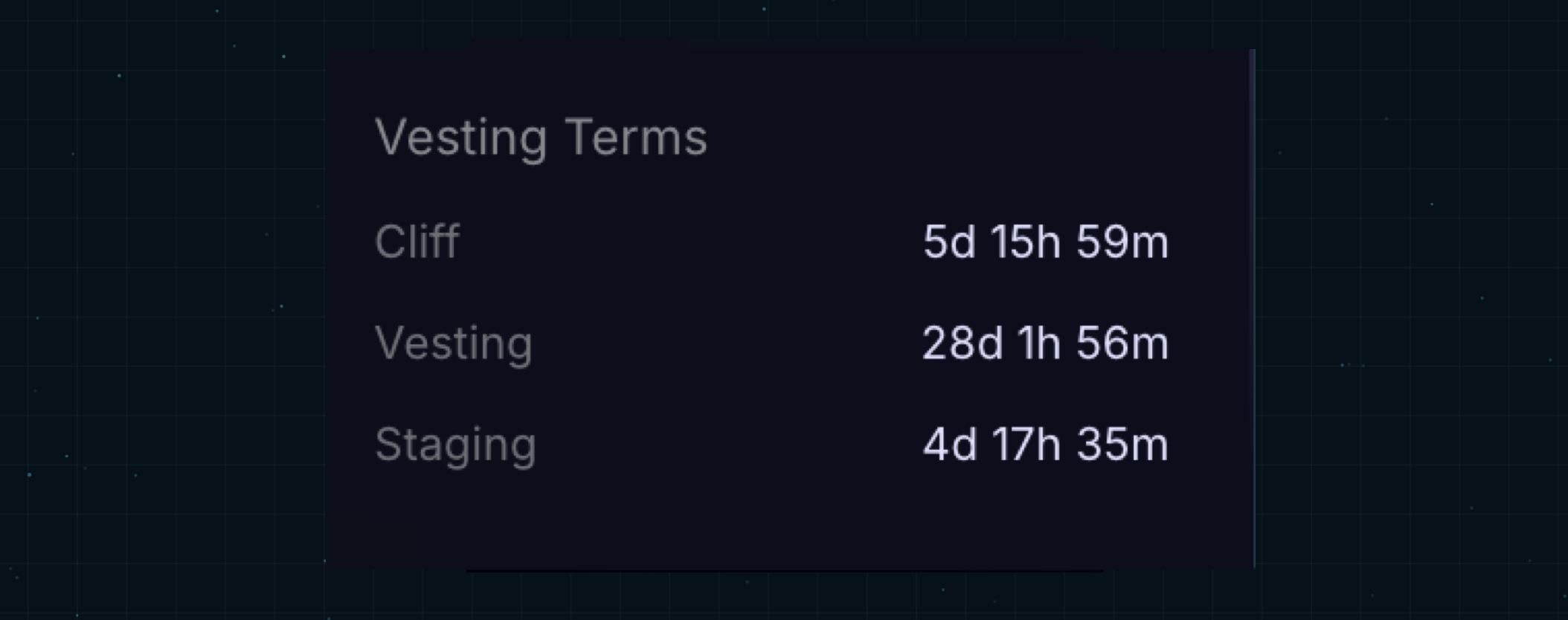
Once you deposit your TitanX, you are allocated a vesting entry which represents a future claim on ORX.  You can vest (or claim) your ORX after 28 days, but if you immediately vest your claim, you will forfeit the vast majority of your tokens (up to 100% if you try to vest before 28 days!).  **Once you early vest a claim, you can never receive this allocation again, and your forfeited tokens will be sent to a forfeit multisig address.** &#x20;

In order to fully claim your ORX allocation, you will need to wait 52 weeks.  The amount of claimable tokens rapidly increases after the 6 month mark.  **The implications of this are that those who are early and patient get the most tokens, but those who arrive later and are more patient than those who are early, can actually surpass those who were early and impatient.**&#x20;

<figure><img src="https://754022034-files.gitbook.io/~/files/v0/b/gitbook-x-prod.appspot.com/o/spaces%2FGBrM5XVsj4G0P2rkCSG1%2Fuploads%2FAbn2dK0d0aYFQW5Gclfh%2Fvesting%20curve.png?alt=media&amp;token=2abbb8da-90a3-439a-90a4-ca629c7ed7bc" alt=""><figcaption><p>Approximate visual of the vesting unlock curve</p></figcaption></figure>

#### 4. A Zero-Inflation Model

The terminal supply of ORX is capped.  Unlike other defi protocols which incentivise user action by diluting token holders, any future ORX staking mechanics which reward in ORX, will need to come from this fixed pool of supply.  Genesis cannot mint more ORX.  The impatient will pay the patient.


# Launch/Participation Mechanics

A detailed breakdown for the launch phase of ORX

<figure><img src="https://754022034-files.gitbook.io/~/files/v0/b/gitbook-x-prod.appspot.com/o/spaces%2FGBrM5XVsj4G0P2rkCSG1%2Fuploads%2FnhVr1ycJRQ7v6CLrLbno%2FScreenshot%202024-09-17%20at%2022.34.14.png?alt=media&amp;token=eaa53ee7-2db1-4f43-9616-8b722cc98732" alt=""><figcaption></figcaption></figure>

### The Simple Route - Deposit TitanX!

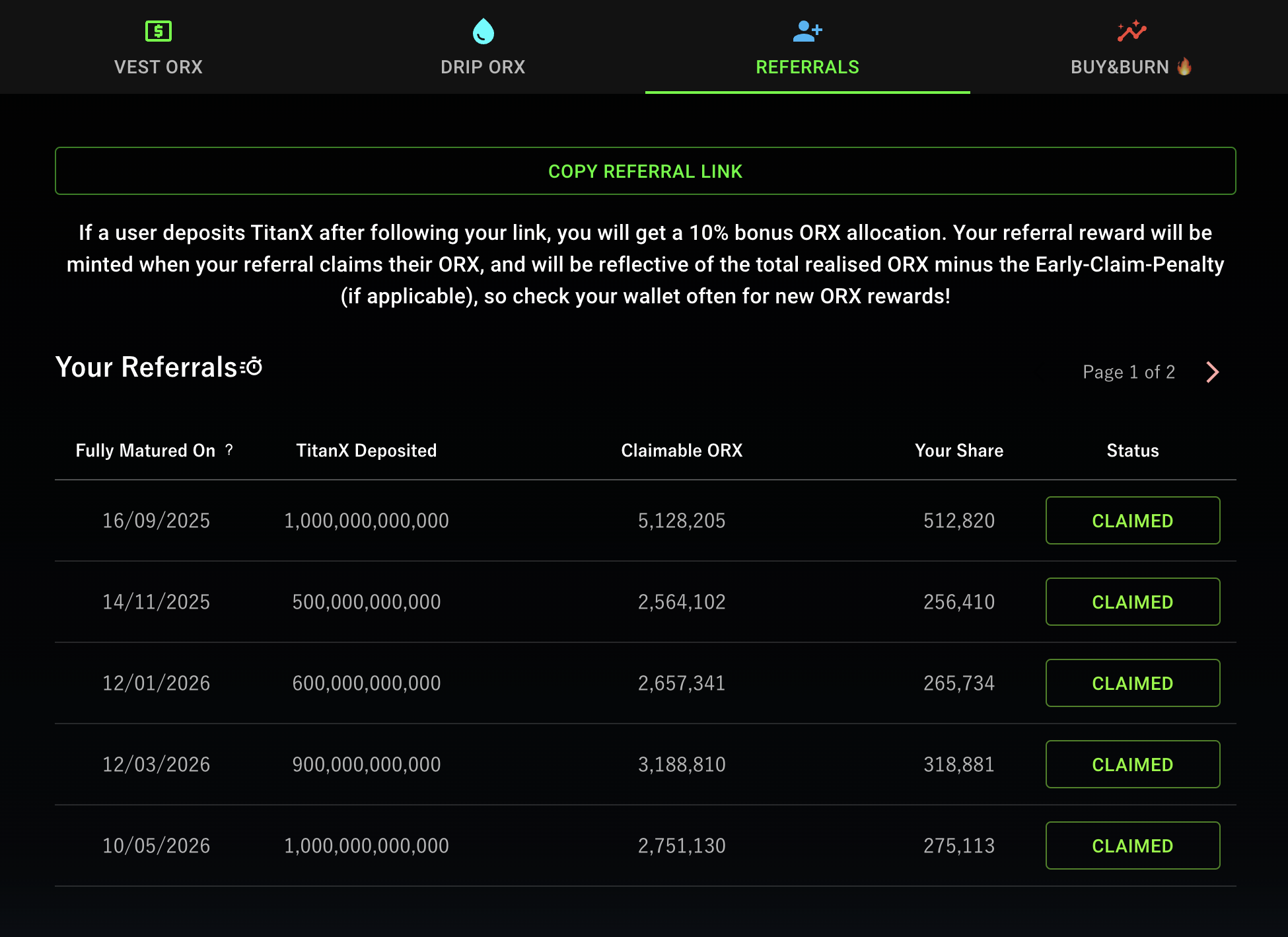
ORX is a TitanX ecosystem asset, and as such, the launch phase is tailored to massively incentivise the locking of TitanX within the ORX minter contract. To achieve this, a massive 95% of supply is given to TitanX deposits.  This is reflected in the expected ROI's of the minter shortly after launch.

<figure><img src="https://754022034-files.gitbook.io/~/files/v0/b/gitbook-x-prod.appspot.com/o/spaces%2FGBrM5XVsj4G0P2rkCSG1%2Fuploads%2FPMiM4dPy1KTM9KwFZ2hH%2FScreenshot%202024-09-17%20at%2022.33.12.png?alt=media&amp;token=5a480182-015f-48a7-b19b-fdb79b1a8504" alt="" width="375"><figcaption><p>Deposit TitanX, and hold for as long as you are willing.</p></figcaption></figure>

For those with little time, or a lack of desire to understand the more complex push/pull factors included in the ORX supply distribution, simply deposit TitanX via the 'DEPOSIT TITANX' tab, and hold for as long as you are comfortable.

You can track the status of your ORX vests in the 'Vest ORX' tab further down the page.

<figure><img src="https://754022034-files.gitbook.io/~/files/v0/b/gitbook-x-prod.appspot.com/o/spaces%2FGBrM5XVsj4G0P2rkCSG1%2Fuploads%2FubTrkd1lHawR08r0eyVQ%2FScreenshot%202024-09-17%20at%2020.08.52.png?alt=media&amp;token=faa79239-8e77-4fc4-b9a5-1889834bdb6e" alt=""><figcaption><p>Track your ORX claims on the VEST ORX tab of the minter</p></figcaption></figure>

## For those who are more risk enabled...

The remainder of this article outlines the various push/pull factors which are aiming to make the minting and distribution mechanics of ORX some of the most interesting in not just TitanX, but all of crypto.

### ORX Acquisition Methods

There are two primary methods of acquiring ORX via the minter.  The first is via TitanX deposits, and the second is via Ethereum deposits.  If both routes needed to be summed up in a sentence:&#x20;

1. **TitanX Deposits:** are for those who want a majority stake in ORX, at the cost of greater time preference, less agility, and a once off claim process which penalises early claims.&#x20;
2. **Ethereum Deposits:** are for those who want to support protocol liquidity, in exchange for the added benefit of capital agility, the earliest unlock time, and progressive unlocking (meaning no early claim penalties).  Since ETH contributors are getting a much smaller percentage of supply, and are directly supporting protocol liquidity, a disproportionate share of future airdrops (IF they happen) MAY go toward ETH contributors.

For a slightly more extended breakdown, but still quite condensed description:&#x20;

### ETH Contributions

<figure><img src="https://754022034-files.gitbook.io/~/files/v0/b/gitbook-x-prod.appspot.com/o/spaces%2FGBrM5XVsj4G0P2rkCSG1%2Fuploads%2Fq3uABFt4Vl5fpaXggF6u%2FScreenshot%202024-09-17%20at%2022.36.35.png?alt=media&amp;token=752f3202-25c6-418f-a986-9a00c20556dd" alt=""><figcaption></figcaption></figure>

When you contribute ETH:

* Your ORX tokens will drip over 12 weeks.
* There's a 21-day waiting period before you can start claiming your ORX.
* After the waiting period, you can claim your ORX tokens gradually as they become available (Drip).
* The exchange rate from ETH to ORX is fixed (135,502 ORX per ETH).
* There's a limit on total ETH contributions. If reached, any excess ETH will be returned to you. You don't need to worry about over paying.
* During the launch period, all ETH is 'staged' for 14 days, meaning they get the same initial unlock time.

<figure><img src="https://754022034-files.gitbook.io/~/files/v0/b/gitbook-x-prod.appspot.com/o/spaces%2FGBrM5XVsj4G0P2rkCSG1%2Fuploads%2FDnc5PeuJ04fg5R0ubYjo%2FScreenshot%202024-10-14%20at%2015.20.41.png?alt=media&amp;token=7ec9081b-1032-410b-a98f-0282bde1b791" alt=""><figcaption><p>Eth Deposit LInear Unlock Curve Schedule</p></figcaption></figure>

### TitanX Deposits

<figure><img src="https://754022034-files.gitbook.io/~/files/v0/b/gitbook-x-prod.appspot.com/o/spaces%2FGBrM5XVsj4G0P2rkCSG1%2Fuploads%2Fl8ugN2ELar6OhfSC45qd%2FScreenshot%202024-09-17%20at%2020.08.52.png?alt=media&amp;token=eb86ec17-3c05-4680-bbd8-757f1edd13c4" alt=""><figcaption></figcaption></figure>

**When you deposit TitanX:**

* Your ORX tokens will vest over 52 weeks.
* There's a 28-day waiting period before you can early claim your ORX.
* The exchange rate from TitanX to ORX will vary based on how much has been deposited in total. **Being earlier is better.**
* Although the rate on this method increases over time, it is still getting a massive share of supply, and as such is the long term way to gain the most ORX.

### Key Differences

1. **Timing:** ETH contributions unlock first, but are much less severe in size.
2. **Vesting Period:** ETH contributions become fully available faster (12 weeks) compared to TitanX deposits (52 weeks).  To balance this, TitanX deposit rewards MASSIVELY outweigh ETH contribution rewards.
3. **Claiming Process:**
   * **For ETH:** After the initial 21-day wait, you can claim gradually until you draw your max reward amount.
   * **For TitanX:** After 28 days, you *may* initiate a claim, and after 3 additional days, mint your ORX.
4. **Onboarding System:** Only TitanX deposits can benefit from onboarding bonuses.
5. **Exchange Rates:** ETH uses a fixed rate, while TitanX rates may change based on total deposits.

<figure><img src="https://754022034-files.gitbook.io/~/files/v0/b/gitbook-x-prod.appspot.com/o/spaces%2FGBrM5XVsj4G0P2rkCSG1%2Fuploads%2FUpl8r6QSoJlv0kyPk4eW%2FScreenshot%202024-10-14%20at%2015.20.30.png?alt=media&amp;token=046be28c-8e9e-46f1-bd99-9567381bb3b6" alt=""><figcaption><p>TitanX Deposit Vest/Forfeit Unlock Curve</p></figcaption></figure>

### **Vesting Schedule & EVF's:**

When you deposit TitanX, you receive a massive share of ORX, but if you claim early, you will forfeit the vast majority of tokens.  EVF's, or "Early Vest Forfeit's" are portions of ORX which are returned to the forfeit sink address (a multisig address which can securely hold the forfeited ORX). &#x20;

## Where Do the Deposited Funds Go?

* 100% of the deposited TitanX is kept within the minter contract for use in the ORX Buy\&Burn.
* 100% of the ETH is routed to a Multisig wallet, with a member of the Ouroboros team present, plus **at least** one other non-team, prominent TitanX community member for accountability and trust purposes.  We can't predict participation in the ETH contribution route, but if fully filled, at *least* 50% of ETH will be used for USDx liquidity provision, with additional capital held in reserve or used for expenses/ecosystem funding.  For a USDx to have liquid value, there needs to be a substantial reserve of liquidity on the books so that true peg stability can be discovered.


# Onboarding System

Details about the onboarding programme for Ouroboros

Spreading awareness about the protocol is incentivised via a **2% bonus mint of ORX for TitanX depositors** who are onboarded by another user.&#x20;

**Example Onboard:**&#x20;

1. You share a link to the Minter by clicking the "Copy Onboarding Link" button.
2. Your onboarded user burns 20 billion TitanX, and receives a max possible claim of 6,666,666 ORX tokens
3. Your onboarded user early claims their ORX, and realises a total of 1 million ORX.&#x20;
4. You, as the onboarder, will have 20,000 ORX minted to your account.&#x20;
5. The total mint for this record is now 1,020,000 ORX.  20k to you, and 1m to your onboarded.

<figure><img src="https://754022034-files.gitbook.io/~/files/v0/b/gitbook-x-prod.appspot.com/o/spaces%2FGBrM5XVsj4G0P2rkCSG1%2Fuploads%2Fo5GpaQZTaMwn7Vnetnq1%2FScreenshot%202024-09-17%20at%2020.58.05.png?alt=media&amp;token=a9bf57b0-c984-4362-916b-3e0d318d7a26" alt=""><figcaption></figcaption></figure>


# Minter Audit

Minter audit conducted by two LSR's, and deployed contracts are verified as being the same as those which were audited.

<figure><img src="https://754022034-files.gitbook.io/~/files/v0/b/gitbook-x-prod.appspot.com/o/spaces%2FGBrM5XVsj4G0P2rkCSG1%2Fuploads%2FXQVRgj8Gy55H5KsDnhlN%2FScreenshot%202024-10-14%20at%2000.01.28.png?alt=media&amp;token=78980d57-8f66-4dd7-80e1-bbef68fd8295" alt=""><figcaption></figcaption></figure>

{% file src="/files/TrM1xaY5DazdV6O7yOOb" %}


# Contract Addresses

<table><thead><tr><th width="234">Name</th><th>Address</th></tr></thead><tbody><tr><td>ORX</td><td><a href="https://etherscan.io/address/0xd536e7a9543cf9867a580b45cec7f748a1fe11ec">0xd536e7a9543cf9867a580b45cec7f748a1fe11ec</a></td></tr><tr><td>ORX Minter</td><td><a href="https://etherscan.io/address/0x4C93D6380D22C44850Bdfa569Df5dD96e278622B">0x4C93D6380D22C44850Bdfa569Df5dD96e278622B</a></td></tr><tr><td>ORX Staking</td><td><a href="https://etherscan.io/address/0xE293DFD4720308c048B63AfE885F5971E135Eb1e">0xE293DFD4720308c048B63AfE885F5971E135Eb1e</a></td></tr><tr><td>3/4 Multisig</td><td><a href="https://etherscan.io/address/0x54FDAcea0af4026306A665E9dAB635Ef5fF2963f">0x54FDAcea0af4026306A665E9dAB635Ef5fF2963f</a></td></tr><tr><td>Backstop Pool Incentives</td><td><a href="https://etherscan.io/address/0x91804513f407aaD860968F59A4a8bdE12E71b9b1">0x91804513f407aaD860968F59A4a8bdE12E71b9b1</a></td></tr><tr><td>USDx/WETH Univ2 Farm</td><td><a href="https://etherscan.io/address/0x429E4593Ef49477894a694f332B0d6515d066A55">0x429E4593Ef49477894a694f332B0d6515d066A55</a></td></tr></tbody></table>


# Ouroboros Products


# USDx Stablecoin

An innovative multi-collateral CDP stablecoin for the TitanX ecosystem

<figure><img src="https://754022034-files.gitbook.io/~/files/v0/b/gitbook-x-prod.appspot.com/o/spaces%2FGBrM5XVsj4G0P2rkCSG1%2Fuploads%2FpjTtv7yXfNX7THj7itFP%2FScreenshot%202024-09-03%20at%2003.41.51.png?alt=media&amp;token=543f26e0-af8c-4914-a0ca-830ec4e6646f" alt="" width="375"><figcaption></figcaption></figure>

USDx presents an innovative ***Multi-Asset*** Collateralised Debt Position (CDP) style stable asset, which uses an elegant system of arbitrage and direct exchange to issue an asset (USDx) which is capable of pegging to an arbitrary price point. For the purposes of initial operation, V1 of USDx will peg exclusively to $1.

#### Goals

The ultimate goal for USDx is to establish itself as the goto stablecoin of choice across the entire TitanX ecosystem, by accommodating for the inclusion of various project assets as collateral in a controlled manner.  The longer terms goals are to branch out, and give the TitanX ecosystem exposure to a rangle of non TX based collaterals and unique collateralisation strategies.&#x20;

**The USDx system operates with the following subcomponents:**&#x20;

1. **Position Managers:** Responsible for the issuance and destruction of debt in the form of USDx.
2. **Unified Backstop Pool:** Accepts USDx deposits which are used for the purpose of rapid debt-position liquidations during periods of downward price volatility.  By depositing USDx, Backstop Pool depositors enjoy rewards in the form of liquidated collateral which is exchanged at a below market-rate ratio.  Sophisticated actors can employ MEV at this layer to rapidly close the arbitrage loop to realise these gains in any asset of their choosing, or instead compound these assets via issuance of additional USDx.&#x20;
3. **Collateral Controller:** A simple but critical piece of USDx, which allows for the addition and decommission of Collateral types, with an aim to including all TitanX ecosystem assets which are deemed suitable for inclusion (subject to review).  This component also contains safety critical features such as debt caps, redemption points (RP), loan points (RP), and various other metrics/settings designed to shore up the system in the presence of volatile collateral assets.&#x20;
4. **ORX Fee Staking Pool:** This pool will accept deposits of ORX, and allow depositors to accrue a share of debt issuance and collateral redemption fees.&#x20;


# ORX Fee Sharing Pool (ORX Staking)

A description of the fee accrual mechanism for ORX stakers within the USDx system.

## ORX Staking

<figure><img src="https://754022034-files.gitbook.io/~/files/v0/b/gitbook-x-prod.appspot.com/o/spaces%2FGBrM5XVsj4G0P2rkCSG1%2Fuploads%2FDoClcg3C943oRkBZHLuo%2FScreenshot%202024-09-17%20at%2015.12.08.png?alt=media&amp;token=4c44e283-732b-4b7c-8ea6-d7294470e373" alt=""><figcaption></figcaption></figure>

All of the revenue USDx makes is diverted to ORX stakers. By staking ORX you are entitled to a pro-rata share of all fees.  To start staking all you need to do is deposit your ORX tokens to the ORX staking contract. Once done you will start earning a pro-rata share of the borrowing and redemption fees in USDx and all Collateral types supported by the protocol.  Your ORX stake will earn a share of the fees equal to your share of the total ORX staked, at the instant the fee occurred.

### Is there a lock-up period? <a href="#is-there-a-lock-up-period" id="is-there-a-lock-up-period"></a>

No, you can withdraw your staked funds at any time.

<figure><img src="https://754022034-files.gitbook.io/~/files/v0/b/gitbook-x-prod.appspot.com/o/spaces%2FGBrM5XVsj4G0P2rkCSG1%2Fuploads%2FcE7vUvBKD0kTpIVRhW06%2FScreenshot%202024-09-17%20at%2015.13.46.png?alt=media&amp;token=8d71cdcb-ff52-4fbe-b194-075d41ad086b" alt=""><figcaption><p>Fees are collatected every time you add to/remove from your stake.</p></figcaption></figure>

### Are staked ORX tokens used for protocol bailouts (like in Maker) or for governance? <a href="#are-staked-lqty-tokens-used-to-backstop-the-system-like-maker-or-for-governance" id="are-staked-lqty-tokens-used-to-backstop-the-system-like-maker-or-for-governance"></a>

No, staked ORX are not used to backstop USDx, and are not used for governance as there is no USDx governance layer **(yet)**.


# Borrowing USDx (USDx Minter)

A brief description of the borrowing functionality within USDx

**What is 'Borrowing' in the context of USDx?**

USDx offers interest-free loans and is more capital efficient than other borrowing systems (i.e. less collateral is needed for the same loan). Instead of selling Collateral (TitanX, DragonX) to have liquid funds, you can use the protocol to lock up your collateral, borrow against it to withdraw USDx, and then repay your loan at a future date.

**For example:** Borrowers speculating on future Collateral price increases can use the protocol to leverage their Collateral positions, increasing their exposure to price changes. This is possible because USDx can be borrowed against (for example) TitanX, sold on the open market to purchase more TitanX — rinse and repeat.\*

\**Note: This is not a recommendation for how to use USDx. Leverage can be risky and should be used only by those with experience.*

### **How can the protocol offer interest-free borrowing?** <a href="#how-can-the-protocol-offer-interest-free-borrowing" id="how-can-the-protocol-offer-interest-free-borrowing"></a>

The protocol charges one-time borrowing and redemption fees that algorithmically adjust based on the last redemption time. For example: If more redemptions are happening (which means USDx is likely trading at less than 1 USD), the borrowing fee would continue to increase, discouraging borrowing.

### **How can I borrow with USDx?** <a href="#how-can-i-borrow-with-liquity" id="how-can-i-borrow-with-liquity"></a>

<figure><img src="https://754022034-files.gitbook.io/~/files/v0/b/gitbook-x-prod.appspot.com/o/spaces%2FGBrM5XVsj4G0P2rkCSG1%2Fuploads%2Fb8TbTSypbvFDTHuk9VqL%2FScreenshot%202024-09-17%20at%2016.53.22.png?alt=media&amp;token=8d95091e-0caa-4723-8d03-da65ba70b1ff" alt=""><figcaption></figcaption></figure>

To borrow you must open a Position and deposit a certain amount of collateral. Then you can draw USDx up to a collateral ratio of the configured MCR (Minimum Collateral Ratio). A **minimum debt** of `2,000 USDx` is required.

### **What is a 'Position'?** <a href="#what-is-a-trove" id="what-is-a-trove"></a>

<figure><img src="https://754022034-files.gitbook.io/~/files/v0/b/gitbook-x-prod.appspot.com/o/spaces%2FGBrM5XVsj4G0P2rkCSG1%2Fuploads%2F4KnxwI7w1SveC3cVpbfM%2FScreenshot%202024-09-17%20at%2016.54.50.png?alt=media&amp;token=038027f6-2c93-4251-b042-4e8ef0c61e23" alt="" width="375"><figcaption></figcaption></figure>

A Position is where you take out and maintain your loan. Each Position is linked to an Ethereum address and each address can have just one Position per Collateral type. If you are familiar with Vaults or CDPs from other platforms, Positions are similar in concept.

<figure><img src="https://754022034-files.gitbook.io/~/files/v0/b/gitbook-x-prod.appspot.com/o/spaces%2FGBrM5XVsj4G0P2rkCSG1%2Fuploads%2FQ4BLc6LxCG5LHyiH5xBE%2FScreenshot%202024-09-17%20at%2016.55.38.png?alt=media&amp;token=63f63bc9-9a2a-431c-95cc-74d79553156a" alt="" width="375"><figcaption></figcaption></figure>

Positions maintain two balances: one is a collateral balance, and the other is a debt denominated in USDx. You can change the amount of each by adding collateral or repaying debt. As you make these balance changes, your Position’s collateral ratio changes accordingly.  You can close your Position at any time by fully paying off your debt.

<figure><img src="https://754022034-files.gitbook.io/~/files/v0/b/gitbook-x-prod.appspot.com/o/spaces%2FGBrM5XVsj4G0P2rkCSG1%2Fuploads%2FysBC16wPTz5QjSlISqEr%2FScreenshot%202024-09-17%20at%2016.56.54.png?alt=media&amp;token=46dff413-517d-4245-9a84-15e4365bd89f" alt="" width="375"><figcaption></figcaption></figure>

### **Do I have to pay fees as a borrower?** <a href="#do-i-have-to-pay-fees-as-a-borrower" id="do-i-have-to-pay-fees-as-a-borrower"></a>

Every time you draw USDx from your Position, a one-off borrowing fee is charged on the drawn amount and added to your debt. Please note that the borrowing fee is variable (and determined algorithmically) and has a minimum value of `0.5%` under normal operation. The fee is `0%` during Recovery Mode.  A `200 USDx` Liquidation Reserve charge will be applied as well, but returned to you upon repayment of debt.

<figure><img src="https://754022034-files.gitbook.io/~/files/v0/b/gitbook-x-prod.appspot.com/o/spaces%2FGBrM5XVsj4G0P2rkCSG1%2Fuploads%2F5HV119ws85uIIyNTOuRo%2FScreenshot%202024-09-17%20at%2016.58.01.png?alt=media&amp;token=1b134b2c-e8c7-41b9-be2a-138ec9cc8432" alt=""><figcaption></figcaption></figure>

Another consideration is the price of USDx at the time of repayment. If at the time you want to repay your loan USDx is trading at $1.02 on the market and you need to buy it, you are incurring a 2% 'fee'. You can avoid this by having your borrowed funds readily available or by being able to wait for USDx to return to peg.

### **How is the borrowing fee calculated?** <a href="#how-is-the-borrowing-fee-calculated" id="how-is-the-borrowing-fee-calculated"></a>

USDx uses a combination of dynamic base rate fee suggestions, collateral settings, and market volitility estimation to feed fee rates back into the protocol.

The borrowing fee is added to the debt of the Position. The loan fee rate is confined to a range between `0.5%` and `5%, or a custom min/max fee setting,` and is multiplied by the amount of liquidity drawn by the borrower.

For example: The borrowing fee stands at `0.5%` and the borrower wants to receive `4,000 USDx` to their wallet. Being charged a borrowing fee of `20.00 USDx`, the borrower will incur a debt of`4,220 USDx` after the Liquidation Reserve and issuance fee are added.

### **When do I need to pay my loan back?** <a href="#when-do-i-need-to-pay-my-loan-back" id="when-do-i-need-to-pay-my-loan-back"></a>

Loans issued by the protocol do not have a repayment schedule. You can leave your Position open and repay your debt any time, as long as you maintain a collateral ratio of at least `110%`.

### What is the collateral ratio? <a href="#what-is-the-collateral-ratio" id="what-is-the-collateral-ratio"></a>

This is the ratio between the Dollar value of the collateral in your Position and its debt in USDx. The collateral ratio of your Position will fluctuate over time as the price of the underly collateral changes. You can influence the ratio by adjusting your Position’s collateral and/or debt — i.e. adding more collateral or paying off some of your debt.

### **What is the minimum collateral ratio (MCR) and the "recommended" collateral ratio?** <a href="#what-is-the-minimum-collateral-ratio-mcr-and-the-recommended-collateral-ratio" id="what-is-the-minimum-collateral-ratio-mcr-and-the-recommended-collateral-ratio"></a>

The minimum collateral ratio (or MCR for short) is the lowest ratio of debt to collateral that will not trigger a liquidation under normal operations (aka Normal Mode). This is a collateral specific parameter that is set by the protocol Guardian. So if we assume an MCR of 110%, and your Position has a debt `10,000 USDx`, you would need at least `$11,000` worth of collateral to avoid being liquidated.

To avoid liquidation during Recovery Mode, it is recommended to keep ratio comfortably above the `CCR (Critical Collateral Ratio).`

### **What happens if my** Position **is liquidated?** <a href="#what-happens-if-my-trove-is-liquidated" id="what-happens-if-my-trove-is-liquidated"></a>

You lose your collateral as your debt is paid off through liquidation, i.e. you will no longer be able to retrieve your collateral by repaying your debt. A liquidation thus results in a net loss of (in the case of MCR of 110%) `9.09% (= 100% * 10 / 110)` of your collateral’s Dollar value.

### **What is the Liquidation Reserve?** <a href="#what-is-the-liquidation-reserve" id="what-is-the-liquidation-reserve"></a>

When you open a Position and draw a loan, `200 USDx` is set aside as a way to compensate gas costs for the transaction sender in the event your Position being liquidated. The Liquidation Reserve is fully refundable if your Position is not liquidated, and is given back to you when you close your Position by repaying your debt. The Liquidation Reserve counts as debt and is taken into account for the calculation of a Position's collateral ratio, slightly increasing the actual collateral requirements.

#### **What happens if my** Position **is redeemed against?** <a href="#what-happens-if-my-trove-is-redeemed-against" id="what-happens-if-my-trove-is-redeemed-against"></a>

When USDx is redeemed, the Collateral provided to the redeemer is allocated from the Position(s) with the lowest collateral ratio (even if it is above the MCR). If at the time of redemption you have the Position with the lowest ratio, you will give up some of your collateral, but your debt will be reduced accordingly.

The USD value by which your collateral is reduced corresponds to the nominal USDx amount by which your Position's debt is decreased. You can think of redemptions as if somebody else is repaying your debt and retrieving an equivalent amount of your collateral. As a positive side effect, redemptions improve the collateral ratio of the affected Positions, making them less risky.

Redemptions that do not reduce your debt to 0 are called partial redemptions, while redemptions that fully pay off a Position's debt are called full redemptions. In such a case, your Position is closed, and you can claim your collateral surplus and the Liquidation Reserve at any time.

### **Why did the collateral and debt of my** Position **increase without my intervention?** <a href="#why-did-the-collateral-and-debt-of-my-trove-increase-without-my-intervention" id="why-did-the-collateral-and-debt-of-my-trove-increase-without-my-intervention"></a>

If Positions are liquidated and the Backstop Pool is empty (or gets emptied due to the liquidation), every borrower will receive a portion of the liquidated collateral and debt as part of a redistribution process.


# Backstop Staking (USDx Staking)

A short description of the functionality and yield opportunities of the 'USDx Staking' Tab

### What is the Backstop Pool?

<figure><img src="https://754022034-files.gitbook.io/~/files/v0/b/gitbook-x-prod.appspot.com/o/spaces%2FGBrM5XVsj4G0P2rkCSG1%2Fuploads%2FMa1A6FZ4kaT1xl8Cst72%2FScreenshot%202024-09-17%20at%2017.15.28.png?alt=media&amp;token=022f9d4d-328e-4ce8-bfbb-df228e30602f" alt=""><figcaption></figcaption></figure>

The Backstop Pool is the first line of defence in maintaining system solvency. It achieves that by acting as the source of liquidity to repay debt from liquidated Positions, ensuring that the total USDx supply always remains backed.  When any Position is liquidated, an amount of USDx corresponding to the remaining debt of the Position is burned from the Backstop Pool’s balance (in the form of USDx) to repay its debt. In exchange, the **entire collateral** from the Position is transferred to the Backstop Pool.

<figure><img src="https://754022034-files.gitbook.io/~/files/v0/b/gitbook-x-prod.appspot.com/o/spaces%2FGBrM5XVsj4G0P2rkCSG1%2Fuploads%2FwtrsSKrOtBcA8iGBGvHi%2FScreenshot%202024-09-17%20at%2017.16.56.png?alt=media&amp;token=5c8576c6-aac6-4bba-aad3-193c5772a7ff" alt="" width="375"><figcaption></figcaption></figure>

The Backstop Pool is funded by users transferring USDx into it (called Backstop Providers). Over time Backstop Providers lose a pro-rata share of their USDx deposits, while gaining a pro-rata share of the liquidated collateral. However, because Positions are likely to be liquidated at just below their MCR, it is expected that Backstop Providers will receive a greater dollar-value of collateral relative to the debt they pay off.

**Note:** Depositors can immediately withdraw the collateral received from liquidations and sell it to reduce their exposure to the collateral, if the USD value of the collateral is expected to decrease.

### Can I withdraw my deposit whenever I want? <a href="#can-i-withdraw-my-deposit-whenever-i-want" id="can-i-withdraw-my-deposit-whenever-i-want"></a>

As a general rule, you can withdraw the deposit made to the Backstop Pool at any time. There is no minimum lockup duration. However, withdrawals are temporarily suspended whenever there are liquidatable Positions with a collateral ratio below `their configured MCR%` that have not been liquidated yet.

### Can I lose money by depositing funds to the Backstop Pool? <a href="#can-i-lose-money-by-depositing-funds-to-the-stability-pool" id="can-i-lose-money-by-depositing-funds-to-the-stability-pool"></a>

While liquidations will occur at a collateral ratio well above `100%` most of the time, it is theoretically possible that a Position gets liquidated below `100%` in a flash crash or due to an oracle failure. In such a case, you may experience a loss since the collateral gain will be smaller than the reduction of your deposit.

If USDx is trading above `$1`, liquidations may become unprofitable for Backstop Providers even at collateral ratios higher than `100%`. However, this loss is hypothetical since USDx is expected to return to the peg, so the “loss” only materializes if you had withdrawn your deposit and sold the USDx at a price above `$1`.

### What happens if the Backstop Pool is empty when liquidations occur? <a href="#what-happens-if-the-stability-pool-is-empty-when-liquidations-occur" id="what-happens-if-the-stability-pool-is-empty-when-liquidations-occur"></a>

If the Backstop Pool is empty, the system uses a secondary liquidation mechanism called redistribution. In such a case, the system redistributes the debt and collateral from liquidated Positions to all other existing Positions. The redistribution of debt and collateral is done in proportion to the recipient Position's collateral amount.


# Liquidations

A brief description of what liquidations are, the liquidation process, threshold, and incentives for liquidators.

<figure><img src="https://754022034-files.gitbook.io/~/files/v0/b/gitbook-x-prod.appspot.com/o/spaces%2FGBrM5XVsj4G0P2rkCSG1%2Fuploads%2FGAcsZSBcZ4wgdzrfzt6G%2FScreenshot%202024-09-17%20at%2017.27.22.png?alt=media&amp;token=cb51d797-3c96-411c-851b-64f537869a27" alt=""><figcaption></figcaption></figure>

### What are liquidations? <a href="#what-are-liquidations" id="what-are-liquidations"></a>

To ensure that the entire stablecoin supply remains fully backed by collateral, Positions which fall under the minimum collateral ratio will be closed (liquidated).  The debt of the Position is canceled and absorbed by the Backstop Pool and its collateral distributed among Backstop Providers. The owner of the Position still keeps the full amount of USDx borrowed but loses value overall; hence, it is critical to always keep your health ratio above the MCR (ideally above CCR.)

### Who can liquidate Positions? <a href="#who-can-liquidate-troves" id="who-can-liquidate-troves"></a>

<figure><img src="https://754022034-files.gitbook.io/~/files/v0/b/gitbook-x-prod.appspot.com/o/spaces%2FGBrM5XVsj4G0P2rkCSG1%2Fuploads%2F6dHp76DOGMLk4gJPSCVL%2FScreenshot%202024-09-17%20at%2019.31.35.png?alt=media&amp;token=8c5b5f5b-7e04-4ab3-b142-7178681caeb9" alt=""><figcaption></figcaption></figure>

Anybody can liquidate a Position as soon as it drops below the Minimum Collateral Ratio. The initiator receives a gas compensation (200 USDx + 0.5% of the Position's collateral) as reward for this service.

### How am I compensated for liquidating a Position? <a href="#how-am-i-compensated-for-liquidating-a-trove" id="how-am-i-compensated-for-liquidating-a-trove"></a>

The liquidation of Positions is connected with certain gas costs which the initiator has to cover. The cost per Position is reduced by implementing batch liquidations of Positions but with the aim of ensuring that liquidations remain profitable even in times of soaring gas prices the protocol offers a gas compensation given by the following formula:

`gas compensation = 200 USDx + 0.5% of Position's collateral`

The 200 USDx is funded by a Liquidation Reserve while the variable 0.5% part comes from the liquidated collateral, slightly reducing the liquidation gain for Backstop Providers.


# Protocol Safety

A description of the various protocol safety measures spread out across all components, presented here in a unified view.

### Rate Limits for Redemptions, and Loan Origination <a href="#are-staked-lqty-tokens-used-to-backstop-the-system-like-maker-or-for-governance" id="are-staked-lqty-tokens-used-to-backstop-the-system-like-maker-or-for-governance"></a>

The protocol implements rate limiting mechanisms for redemptions and loan originations, as well as various controls for settings such as: min/max interest settings for loans/redemptions, and a redemption timeout fee. These mechanisms help manage system risk and prevent sudden large-scale actions that could destabilize the protocol.

In particular, the rate limits allow the creation of a much more fine grained 'protocol usage' metric, which can feed useful fee data into the oracles (which themselves provide fee recommendations back to the protocol core).

### Redemption Rate Limits

1. **Redemption Points**: The system uses a point-based system to limit redemptions.
   * There's a maximum number of redemption points (`maxRedemptionPoints`).
   * Available redemption points regenerate over time up to the maximum.
2. **Regeneration**:
   * Points regenerate at a set rate per minute (`redemptionRegenerationRate`).
   * The current available points can be calculated using `redemptionPointsAt()`
3. **Consumption**:
   * Redemptions consume these points.
   * If a redemption would exceed available points, it's rejected.
   * 1 redemption point is equal to one nominal USDx, regardless of market price.
4. **Cooldown and Grace Period**:
   * There's a cooldown period between redemptions (`redemptionCooldownPeriod`).
   * A grace period (`redemptionGracePeriod`) allows redemptions shortly after the cooldown without penalty.
   * Redemptions after the grace period incur a timeout fee (`redemptionsTimeoutFeePct`).
   * Once a redemption is queued, it must be executed after the cooldown period, or else there would be no penalty for repeating redemption attempts.

### Loan Origination Rate Limits

1. **Loan Points**: Similar to redemptions, loan originations use a point-based system.
   * Maximum loan points (`maxLoanPoints`) set the upper limit.
   * Available loan points regenerate over time.
2. **Regeneration**:
   * Points regenerate at a set rate per minute (`loanRegenerationRate`).
   * Current available points can be calculated using `loanPointsAt()`.
3. **Consumption**:
   * Loan originations consume these points.
   * If a loan would exceed available points, it's rejected.
   * 1 loan point is equal to one nominal USDx, regardless of market price.
4. **Cooldown and Grace Period**:
   * There's a cooldown period between loan origination and claiming(`loanCooldownPeriod`).&#x20;
   * During the loan cooldown period, issued USDx is held in escrow, and can only be unlocked following the lockup period.&#x20;
   * During the lockup, if a users position fails to meet the minimum (or critical in the case of recovery mode) collateral ratio, then the claim functionality becomes a 'Self Liquidate' action.  Triggering self liquidation will result in all funds being returned to the loan issuance contract, for later burning or fee collection.
   * A grace period (`loanGracePeriod`) is present to prevent funds becoming blocked in a users account.  Before the grace period, only the originator can claim/liquidate, but after the grace period, fee stakers have an incentive to claim/liquidate on their behalf.

### Administrative Controls on a per Collateral Type Basis

1. **Debt Cap**: a maximum debt cap for each collateral type can be set.  This is distinct from the loan points, because it acts as an absolute cap on debt rather than a rate limiting cap.
2. **Collateral Requirements**:
   * Minimum Collateral Ratio (MCR) and Critical Collateral Ratio (CCR) can be set.
   * These control the minimum collateralization levels for positions, and the threshold after which recovery mode kicks in.
3. **Fee Settings**:
   * minimum and maximum fees for both borrowing and redemptions.
   * A base rate system allows for dynamic fee adjustments, which is independent of explicit fee settings.
4. **Collateral Lifecycle Management**:
   * Collateral types go through stages: commissioning, active, decommissioned, and sunset.
   * The commissioning period is a 3 day window.
   * Each stage has different restrictions and capabilities.
     * Commissioning: Staged, but not active.
     * Active: Normal operation
     * Decommissioned: 3 month window during which debt can only be drawn down.  This gives users a chance to gracefully exit positions
     * Sunset: Deactiviated.  In this case, collateral still in the system is considered orphaned, and can be collected by the protocol Guardian.
5. **Point System Management**:
   * Adjustments for max points, regeneration rates, and available points for both redemptions and loans.

These rate limiting mechanisms allow for fine-tuned management of the system's risk and liquidity, helping to ensure stability and prevent potential exploits or sudden liquidity crises.

### Loan Clawbacks for Bad Debt <a href="#are-staked-lqty-tokens-used-to-backstop-the-system-like-maker-or-for-governance" id="are-staked-lqty-tokens-used-to-backstop-the-system-like-maker-or-for-governance"></a>

As part of the protection measures put in place to facilitate the inclusion of more volatile assets, USDx features a loan clawback mechanism which prevents price manipulation which aims to secure a higher than 'fair' value for collateral deposited for the purposes of loan origination.&#x20;

1. Escrow Period: When a user borrows USDx against their collateral, the borrowed amount may be subject to an escrow period. During this time, the stablecoins are held in escrow rather than being immediately available to the borrower.
2. Cooldown Requirement: The system enforces a "loan cooldown" period, which is the minimum duration the borrowed USDx must remain in escrow.
3. Claiming Process: After the cooldown period expires, borrowers can initiate a claim to access their borrowed USDx. However, the success of this claim depends on several factors: a. Recovery Mode: If the system is in Recovery Mode (a state triggered by low collateralization ratios), claims must satisfy the current CCR (Critical Collateral Ratio setting). b. When not in recovery mode, the Individual Collateralization Ratio (ICR): The borrower's position must maintain a healthy collateralization ratio to successfully claim the escrowed stablecoins.  USDx generated against a liquidatable position are NOT claimable. c. Grace Period: There's a short grace period after the cooldown expires during which only the original borrower can claim the escrowed stablecoins. After this period, anyone can claim/clawback the funds.
4. Clawback Conditions: If a borrower's position becomes undercollateralized or if market conditions deteriorate significantly, the protocol may "claw back" the escrowed USDx. In this case: a. The escrowed USDx are not released to the borrower. b. Instead, they are redirected to the protocol's contracts.&#x20;
5. Reward Distribution: Any clawed-back USDX that are not burned may be distributed as rewards/fee income to ORX stakers at the discretion of the protocol guardian.


# Educational Track

A quick, user centric set of articles which equip you with the knowledge for effective participation in the USDx protocol

* [1. USDx Users & What they Care About](/ouroboros-products/usdx-stablecoin/educational-track/1.-usdx-users-and-what-they-care-about)
* [2. Your First Loan & What to Monitor While your Loan is Open](/ouroboros-products/usdx-stablecoin/educational-track/2.-your-first-loan-and-what-to-monitor-while-your-loan-is-open)
* [3. Participating in Liquidations & USDx Staking Rewards](/ouroboros-products/usdx-stablecoin/educational-track/3.-participating-in-liquidations-and-usdx-staking-rewards)
* [4. Redemptions & How the Peg Holds](/ouroboros-products/usdx-stablecoin/educational-track/4.-redemptions-and-how-the-peg-holds)


# 1. USDx Users & What they Care About

Knowing what you want from the platform will help you contextualise risk.  Find out which category of user you fit into, and adjust how you use the platform accordingly.

Broadly speaking, there are four primary users of USDx.  How you use loaned USDx will depend on the type of user you are.  In order of rising complexity, those users are:&#x20;

1. **USDx Trader**
2. **USDx Leverage Trader**
3. **USDx Yield Speculator**
4. **USDx Arbitrageur**

**Things all users care about:**&#x20;

1. **Platform Safety:**  ALL defi products (platforms, tokens, wallet, etc) carry tech risk.  USDx has minimised platform/tech risks by:
   1. Undergoing extensive auditing by industry leading experts.
   2. Long and thorough testing process, considering many edge cases.&#x20;
   3. Using a battle tested and proven baseline codebase for loan/liquidation logic.&#x20;

With that said, let's talk about the *user type* specific considerations.

### **USDx Trader**

<div align="left" data-full-width="false"><figure><img src="https://754022034-files.gitbook.io/~/files/v0/b/gitbook-x-prod.appspot.com/o/spaces%2FGBrM5XVsj4G0P2rkCSG1%2Fuploads%2FpjTtv7yXfNX7THj7itFP%2FScreenshot%202024-09-03%20at%2003.41.51.png?alt=media&amp;token=543f26e0-af8c-4914-a0ca-830ec4e6646f" alt="" width="375"><figcaption></figcaption></figure></div>

These users use USDx as a store of value, and simply swap in and out of it.  They don't take part in the loaning process, they simply enjoy the benefits of USDx as a stable unit of account and store of value. &#x20;

**They care about:**

1. **Liquidity Depth:** Check DEX information providers (eg, dexscreener), or LP info providers like parsec or revert.finance
2. **Peg stability:** Check price history for average time to peg reversion
3. **Protocol solvency:** Check \`Aggregate Health Ratio\` on <https://ouroboros.foundation/usdx#/system-stats>.  If this figure is greater than 100%, it means that every USDx is backed by at least $1 of collateral :white\_check\_mark:

### **USDx Leverage/Loan Trader**

<div align="left"><figure><img src="https://754022034-files.gitbook.io/~/files/v0/b/gitbook-x-prod.appspot.com/o/spaces%2FGBrM5XVsj4G0P2rkCSG1%2Fuploads%2FZqbWywqzaWGEScHKWe3L%2FScreenshot%202025-01-22%20at%2013.15.31.png?alt=media&amp;token=e23ec61a-b3d8-47c7-99b0-bb9b64fcfb4c" alt="" width="375"><figcaption></figcaption></figure></div>

These users use the loan facility in USDx to mint USDx, and then use that USDx to purchase other assets to make amplified gains.

**They care about:**

1. **Everything a** [#usdx-trader](#usdx-trader "mention") **cares about**
2. **Their Loan Liquidation Level:** Check <https://ouroboros.foundation/usdx#/usdx-minter> \`Liq Price\` figure, but be aware that if `Global Health` on the same page falls below the \`Critical Collateral Ratio(CCR)\`, then this liquidation price may rise.&#x20;
3. **Buying USDx Below $1 for Discounted Loan Repayments:** All debt in USDx is denominated in USDx, regardless of what the actual price of USDx is.  In other words, if you have outstanding debt of 10,000 USDx, but USDx is trading for 50c, then you can buy 10,000 USDx for 5,000 USD, and repay your debt at a 50% discount in 'real value' terms.
4. **Redemption Pressure/Their Ordering in the Redemption Queue:** When USDx price drops below $1, other users may buy USDx below $1, and exchange it for collateral worth $1.  This ensures USDx maintains a $1 peg. When redemptions occur, they happen on the loan with the lowest health for the target asset.  This is done to ensure that the most 'risky' loans are the ones closed first.   For now, to get an idea of how far down the list your loan is, use the liquidation page loan table to get an idea of how much debt exists in front of your position.  <https://ouroboros.foundation/usdx#/liquidations>

<div data-full-width="false"><figure><img src="https://754022034-files.gitbook.io/~/files/v0/b/gitbook-x-prod.appspot.com/o/spaces%2FGBrM5XVsj4G0P2rkCSG1%2Fuploads%2FQ0ktVVSGZ5P0zMncRdY3%2FScreenshot%202025-01-22%20at%2014.59.25.png?alt=media&amp;token=a73fc9cd-98fa-4ca8-91e8-cb752a10f5b6" alt="" width="563"><figcaption></figcaption></figure></div>

### **USDx Yield Speculator**

This user will mint or buy USDx primarily to access yield opportunities within the ecosystem.  The following sources of yield will be available at launch:&#x20;

1. **LP Rewards** in TitanFarms
2. **Backstop Pool** ORX inflationary rewards (if activated)
3. **Backstop Pool** liquidation rewards (if compounding)

<figure><img src="https://754022034-files.gitbook.io/~/files/v0/b/gitbook-x-prod.appspot.com/o/spaces%2FGBrM5XVsj4G0P2rkCSG1%2Fuploads%2FdhMXhbH4uhzmN3NF5Se4%2FScreenshot%202025-01-22%20at%2015.18.41.png?alt=media&amp;token=e5bcd576-853e-46cc-9a4d-27a8cb1bfb0a" alt=""><figcaption></figcaption></figure>

**They care about:**

1. **Everything a** [#usdx-trader](#usdx-trader "mention") **cares about**
2. ***Maybe*****&#x20;everything a** [#usdx-leverage-loan-trader](#usdx-leverage-loan-trader "mention") cares about (if they loaned and care about collateral exposure being maintained).  This is a 'maybe', because the yield chaser may have simply bought the USDx on the market.&#x20;
3. **Sustainability of Yield**
4. **Reward Rebalancing:** If participating in the Backstop Pool, liquidation rewards may need to be converted into USDx in order to top-up your USDx Backstop Pool deposits, or added as collateral to the user's open loan (if present) to allow more debt to be taken in its place.&#x20;

### **USDx Arbitrageur**

This user takes advantage of pricing discrepancies between USDx and $1, and the liquidation reward discounts enjoyed by USDx Backstop Pool depositors.  Some actions they perform:&#x20;

1. Buying USDx under $1 to redeem
2. Having USDx in the liquidation pool for receiving discounted collateral
3. Having collateral ready to mint USDx and sell it down if it goes above $1

**They care about:**

1. **Everything a** [#usdx-trader](#usdx-trader "mention") **cares about:** But with the caveat that they may care about those things less so, as they typically hold USDx for shorter durations of time on average.
2. **Market volatility:**  Greater volatility creates more arbitrage opportunities.
3. **Gas and Fee Structure Cost:**  Greater costs of operations mean less margin for profit.

### **Next Up**

As we push through the remainder of the explainer articles, keep in mind what type of user (or combo of users) you are likely to be.  Doing so will help you hone your understanding of the mechanics which are related directly to you.&#x20;


# 2. Your First Loan & What to Monitor While your Loan is Open

How to take a loan, and what to look out for to ensure loan performance meets your expectation.

Every USDx is loaned into existence.  USDx will typically be loaned into existence by users wishing to leverage and free up their collateral value without selling the underlying collateral (**USDx Leverage Traders**), or by people wishing to utilise USDx to gain access to yield opportunities (**USDx Yield Speculators**).

USDx loans can unlock massive capital efficiencies and opportunities for amplified capital deployment, so let's see how we can get started by taking out our first USDx loan :point\_down:

### Loan Opening Process (TitanX example)

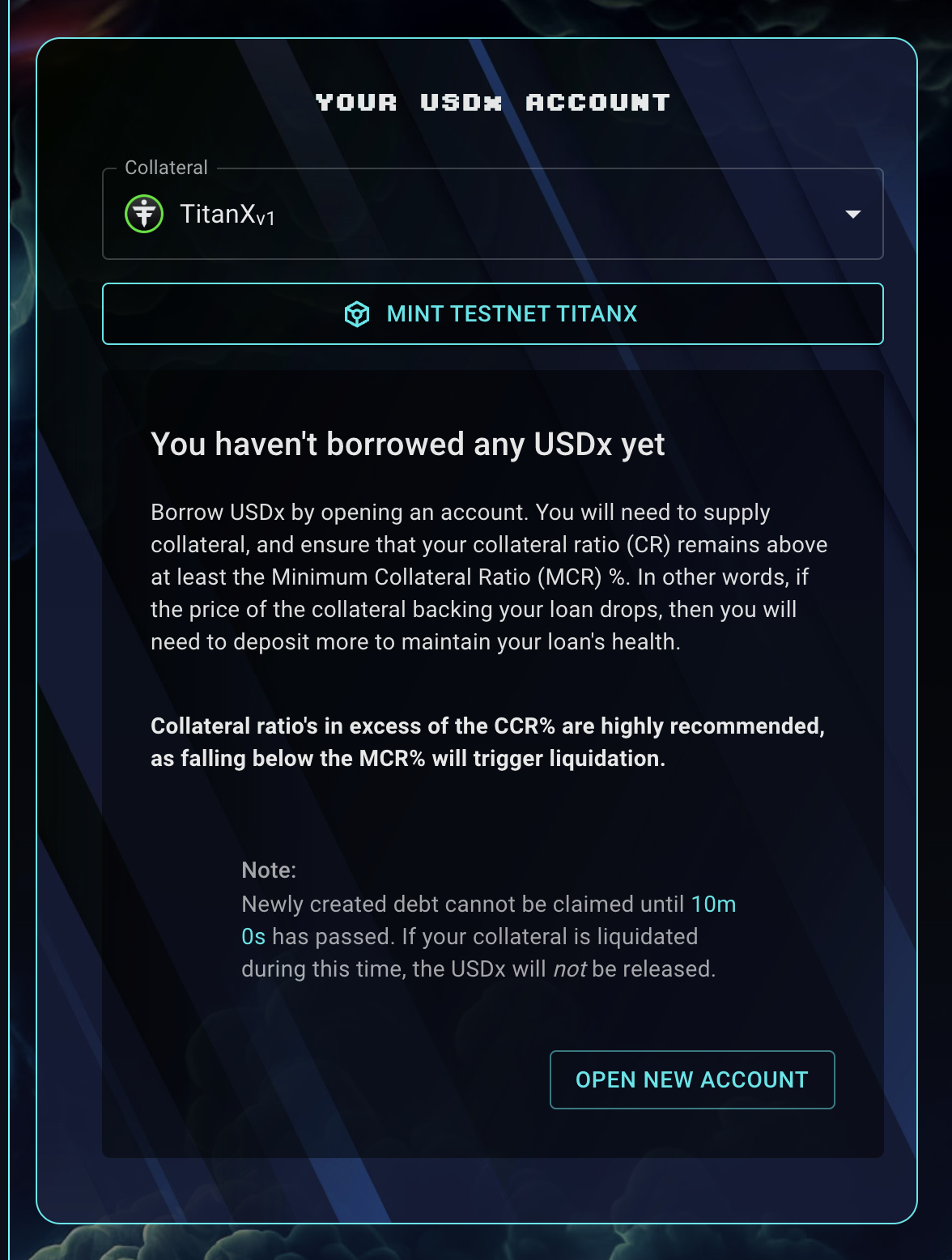
1. Visit <https://ouroboros.foundation/usdx#/usdx-minter>, and connect your wallet.  On this screen, you will be presented with the loan management page.

<figure><img src="https://754022034-files.gitbook.io/~/files/v0/b/gitbook-x-prod.appspot.com/o/spaces%2FGBrM5XVsj4G0P2rkCSG1%2Fuploads%2F1lq7RuFQRuqJ4LGsaq5S%2FScreenshot%202025-01-23%20at%2017.40.42.png?alt=media&amp;token=84120391-5880-4146-b763-0394ad896261" alt="" width="375"><figcaption></figcaption></figure>

2. Ensure you have at least $2,500 worth of collateral in your wallet (but ideally, a lot more)
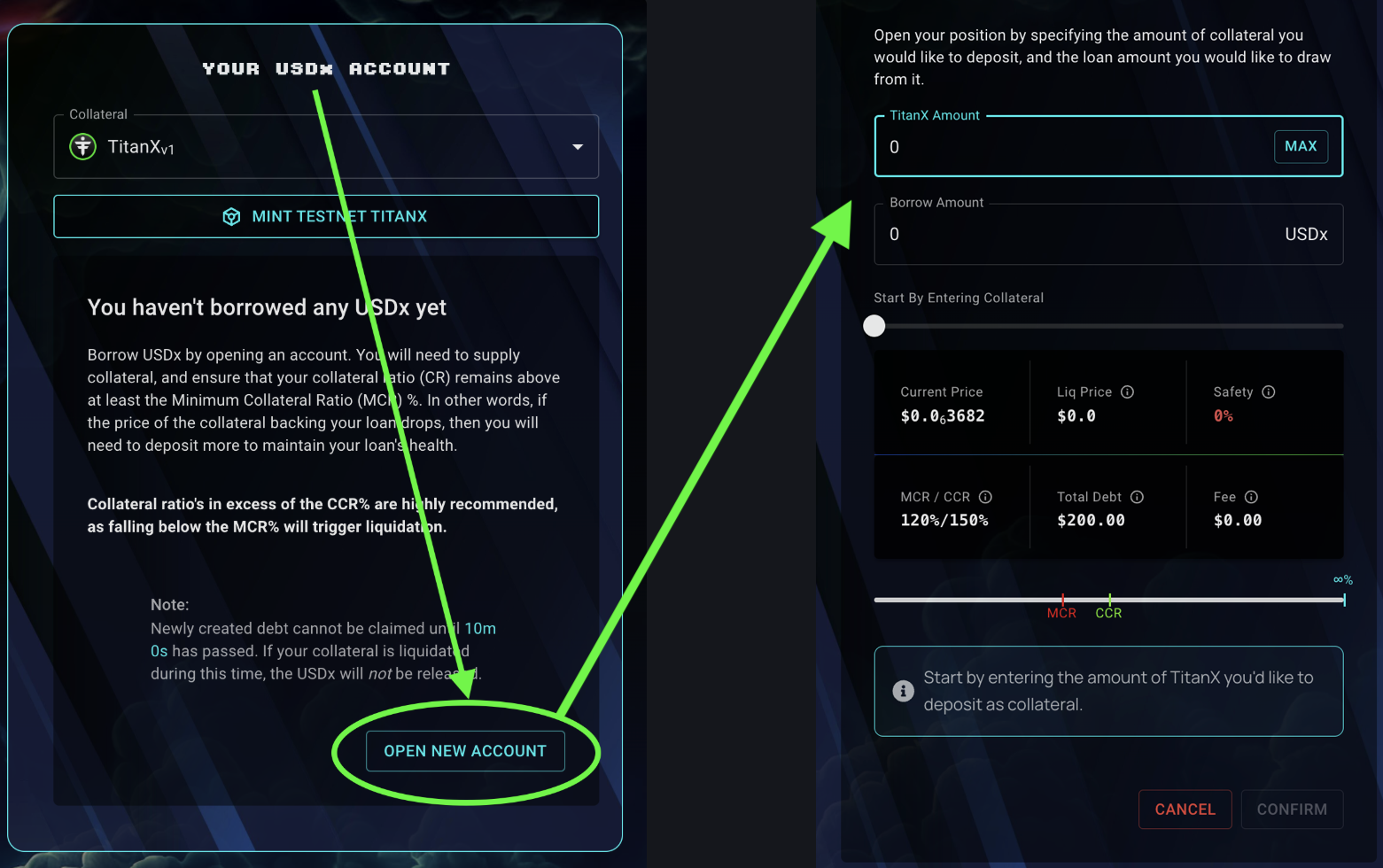
3. Click <mark style="color:blue;">`OPEN NEW ACCOUNT`</mark>
4. Enter the amount of collateral you would like to secure your loan with, and also the amount of USDx you would like to draw against it.  Alternatively, enter an amount of collateral, and use the slider to increase or decrease your loan amount.

<div data-full-width="true"><figure><img src="https://754022034-files.gitbook.io/~/files/v0/b/gitbook-x-prod.appspot.com/o/spaces%2FGBrM5XVsj4G0P2rkCSG1%2Fuploads%2Fro4NmXG1Lv6Lf1d13VtK%2FScreenshot%202025-01-23%20at%2018.31.25.png?alt=media&amp;token=3d985f48-16c0-4f68-8715-864c120e2c10" alt=""><figcaption></figcaption></figure></div>

<figure><img src="https://754022034-files.gitbook.io/~/files/v0/b/gitbook-x-prod.appspot.com/o/spaces%2FGBrM5XVsj4G0P2rkCSG1%2Fuploads%2F7GXM81dBQ1jKgyou4y9t%2FScreenshot%202025-01-23%20at%2019.03.38.png?alt=media&amp;token=84d79c26-7275-4139-ac9e-7dc35941eeee" alt="" width="375"><figcaption><p>These figures help you assess loan risk</p></figcaption></figure>

When entering your collateral and loan amount, the above informational displays will update to give you a sense of the overall risk to the collateral of your loan.&#x20;

* **Current Price:** The current price of the collateral asset (in this case, TitanX)
* **Liq Price:** The price at which your loan collateral becomes liquidatable by the protocol.  If you are liquidated, you will lose your collateral, but keep your loaned USDx (if not currently in escrow.  See below)
* **Safety:** The price drop in the collateral asset which would trigger your liquidation.  In this case, TitanX would need to fall from `0.0000003728` to `0.0000001231` to liquidate your loan, which would equate to a 67% price drop.  `(0.0000003728-0.0000001231)/0.0000003728 == 67%~` drop.  ***In other words: the higher this number, the safer your loan.***
* **MCR/CCR:** The Minimum(M) and Critical(C) Collateral Ratios (CR) for the collateral. Explained simply here, as this is a beginners tutorial:&#x20;
  * **MCR:** Collateral ratio below which you WILL be liquidated.
  * **CCR:** Collateral ratio below which you MIGHT be liquidated IF the `Global Health` falls below the CCR.&#x20;
  * <mark style="color:yellow;">**CHEAT-CODE: Always keep your collateral ratio above the CCR to account for all cases**</mark> :white\_check\_mark:
* **Total Debt:** Your entire debt including fees and refundable liquidation gas fee ($200).
* **Fee:** The one time fee charged for issuance of new debt.

5. Once you have configured your loan as desired, <mark style="color:blue;">`APPROVE`</mark> the collateral, and once approved, <mark style="color:blue;">`CONFIRM`</mark> the loan.&#x20;

<figure><img src="https://754022034-files.gitbook.io/~/files/v0/b/gitbook-x-prod.appspot.com/o/spaces%2FGBrM5XVsj4G0P2rkCSG1%2Fuploads%2F8wNluXZGtU2viXhFWOzp%2FScreenshot%202025-01-23%20at%2019.45.28.png?alt=media&amp;token=68115ed5-9371-49e9-94ff-8f696c4900bf" alt="" width="563"><figcaption></figcaption></figure>

5. Your USDx will now **either**:&#x20;
   1. Appear in your wallet directly, requiring no further action on your part :tada:
   2. Go into `escrow`, and **require that you claim it after a cooldown timer has completed.** &#x20;

<figure><img src="https://754022034-files.gitbook.io/~/files/v0/b/gitbook-x-prod.appspot.com/o/spaces%2FGBrM5XVsj4G0P2rkCSG1%2Fuploads%2FuvuDzyUxRxRvbioNaDeR%2FScreenshot%202025-01-23%20at%2019.09.28.png?alt=media&amp;token=5facbd0d-e2da-4eb9-b3cd-336560ea64b5" alt="" width="375"><figcaption><p>If the USDx is escrowed, you will see the following timer</p></figcaption></figure>

### The USDx Loan Escrow Process&#x20;

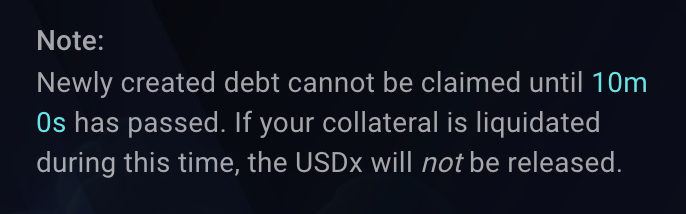
If you see the following notice on a collateral, you will be required to wait a short amount of time before your newly created USDx is released to your wallet.  **As stated, if your position is liquidated during this time, the USDx will&#x20;*****not*****&#x20;be released to your wallet.**

<figure><img src="https://754022034-files.gitbook.io/~/files/v0/b/gitbook-x-prod.appspot.com/o/spaces%2FGBrM5XVsj4G0P2rkCSG1%2Fuploads%2FmcaQZt1iWEzN988KNlsU%2FScreenshot%202025-01-23%20at%2021.43.09.png?alt=media&amp;token=ca226ae0-9ddd-48d4-adfb-14380e8ded82" alt=""><figcaption></figcaption></figure>

After completing the steps above, you will see a countdown timer and a claim button on your loan overview screen.  Be sure to claim your USDx after the timer expires, and complete the escrow process, **as no additional debt will be mintable to your position until doing so.**&#x20;

<div data-full-width="true"><figure><img src="https://754022034-files.gitbook.io/~/files/v0/b/gitbook-x-prod.appspot.com/o/spaces%2FGBrM5XVsj4G0P2rkCSG1%2Fuploads%2FMIOxVxib5tLb2pNxqW9e%2FScreenshot%202025-01-23%20at%2021.58.39.png?alt=media&amp;token=b1d80049-7177-450e-b1b7-7e8a9a2f7d7c" alt=""><figcaption></figcaption></figure></div>

At this stage, you have successfully minted USDx to your account, and can use it as you wish.  However, it's important to keep an eye on your loan, to ensure a healthy state, and verify that you can continue to enjoy price exposure to the underlying collateral (if desired).&#x20;

### Managing Risk, and Maintaining Collateral Exposure

After your loan is created, there are three major items you should monitor depending on how you intend to use the platform.  **Redemptions, Liquidation Risk**, and how close the system is to **Recovery Mode**.  Each of these have a unique impact on your collateral/debt exposure, and liquidation level.&#x20;

None of the following topics are intrinsically negative, and are in fact central to how the system operates.  However, much like Impermanent Loss is a consideration in UniswapV2, and 'In Range Liquidity' is a consideration in UniswapV3, Redemption volume and Collateral Ratios should be an explicit consideration in USDx.&#x20;

#### Predicting and Understanding Redemption impact on Loans

USDx is redeemable at any given moment, for $1 worth (minus fees) of collateral.  **The order in which collateral is redeemable**, progresses according to the health of open loans, in ascending order.  In other words, **redemptions progress from the least collateralised loans, to the most collateralised loans.**  To get a visual ordering of redeemable loans, you can view positions in order of ascending health on:  <https://ouroboros.foundation/usdx#/liquidations>

<figure><img src="https://754022034-files.gitbook.io/~/files/v0/b/gitbook-x-prod.appspot.com/o/spaces%2FGBrM5XVsj4G0P2rkCSG1%2Fuploads%2FwH1R6xjeWAKqOkC4CgHX%2FScreenshot%202025-01-24%20at%2000.37.41.png?alt=media&amp;token=f54e0dd2-083c-46d4-a288-75fa4010abed" alt=""><figcaption><p>First $38k is redeemed, then $2160, and so on...</p></figcaption></figure>

So simply, what are the key takeaways for the purposes of ongoing monitoring of your loan with regard to redemptions?

1. **If you wish to maintain full exposure to your underlying collateral** (TitanX), monitor your loan frequently to ensure that you are decently 'deep' into the list of loans by order of health.  This gives you time to react, in the case that you move closer to the front of the queue, and may be redeemed against.  If you wish to maintain collateral exposure, improve your health by either depositing additional collateral, or paying off debt.&#x20;
2. If you do happen to be redeemed against, but still want the TitanX collateral, you can repurchase it from the market if desired, using your USDx or other asset which was procured with USDx.  Redemptions fundamentally *deleverage* your loan, meaning if you want that leverage to remain, it's up to you to adjust your portfolio accordingly.&#x20;
3. If you want to avoid redemptions, adopt a strategy of being 'relatively healthy' compared to other users in the system.&#x20;

#### Liquidation Risk & the Impact of Recovery Mode on your Liquidation Level

During times of downward price movement in the underlying collateral, you should check your loan frequently to ensure that you are not dangerously close to liquidation.  In a collateral with a healthy Total Collateral Ratio (TCR), it is sufficient to ensure this stays above the MCR (120% for TitanX).  If however, the TCR is close to the CCR of 150%, the system may enter what is called `Recovery Mode`.  **In this mode, loans with a health ratio of below 150% can be liquidated.**&#x20;

**The decision tree here is simply:**&#x20;

1. If you wish to maintain a risky loan (IE, 150% CR and below), you should frequently check the Global Health of the collateral on your loan page, to ensure that the system will not enter recovery mode.&#x20;
2. If you wish to operate as safely as possible, maintain a health ratio above 150% at all times.&#x20;

<figure><img src="https://754022034-files.gitbook.io/~/files/v0/b/gitbook-x-prod.appspot.com/o/spaces%2FGBrM5XVsj4G0P2rkCSG1%2Fuploads%2Fh1h3owWR9MEgYDGFl3rq%2FScreenshot%202025-01-23%20at%2020.42.21.png?alt=media&amp;token=ef5cfaac-5bb6-42fb-80ea-2de6b6acba64" alt="" width="375"><figcaption><p>Global Health, or TCR, can be tracked on your loan page here. </p></figcaption></figure>
### In Summary

USDx loans are a powerful tool, which can unlock massive capital efficiencies in the right hands.  In the most simple case, you open a modest loan, and use your USDx as you wish.  How you monitor that loan after, is all down to what you want to get out of it. &#x20;

Monitor and understand your loan in the same way you would a UniswapV2 or V3 position, in full knowledge of the mechanics which underpin it, and you will never have an unexpected outcome or surprise deleveraging via either Redemptions or Liquidations.  People often don't get `rekt` by loans, they simply are surprised by seeing an unexpected outcome, much like some people are surprised when they provide LP to earn fees, but then find their LP contains much less of the coin which ran 100x than when they first provided liquidity! (Impermanent Loss).&#x20;


# 3. Participating in Liquidations & USDx Staking Rewards

Minted USDx can be used to participate in the liquidation process, while simultaneously earning rewards.  Find out how you can participate and earn additional income with your USDx.

Liquidations in USDx operate by storing a pool of USDx within the protocol in a place called the "BackstopPool", and using that USDx to offset debt and unlock collateral when a loan becomes endangered (health falls below the MCR). &#x20;

In order to incentivise USDx deposits to the BackstopPool, the following incentives are presented to depositors:&#x20;

1. Inflationary ORX rewards (if turned on).  See *Backstop Pool incentives* allocation in [The Ouroboros ($ORX) Token](/the-ouroboros-usdorx-token) supply breakdown.&#x20;
2. The ability to purchase discounted collaterals automatically during liquidations

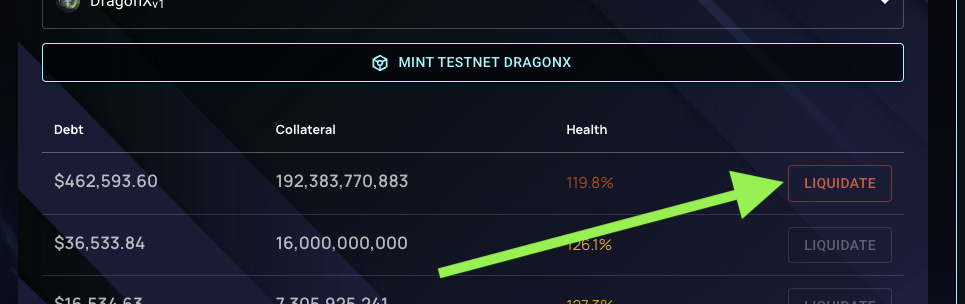
Once this central pool of USDx is ready, the protocol still requires manual intervention by either bots, or regular users, in order to trigger liquidation transactions.  These transactions are individually incentivised via a **collateral, and USDx rewards.** 200 USDx, and 0.5% of the liquidated collateral, are available for simply clicking the Liquidate button on an endangered loan, or using the batch liquidator.&#x20;

Note: Liquidations can be monitored and triggered here: [ouroboros.foundation/usdx#/liquidations](https://ouroboros.foundation/usdx#/liquidations)

<figure><img src="https://754022034-files.gitbook.io/~/files/v0/b/gitbook-x-prod.appspot.com/o/spaces%2FGBrM5XVsj4G0P2rkCSG1%2Fuploads%2FskFOxzkzlojhX77dW5ek%2FScreenshot%202025-01-29%20at%2013.51.06.png?alt=media&amp;token=e9c4de2a-d9c3-40ed-8c76-7b5f77f323a5" alt=""><figcaption><p>Trigger pending liquidations, and get 200 USDx + some of the liquidated collateral <a href="https://emojipedia.org/money-with-wings">💸</a></p></figcaption></figure>

So now that we know where the capital comes from when performing liquidations, and how they are triggered, let's talk about how to provide to that pool of liquidating capital (the Backstop Pool), what happens to the staked/supplied USDx in that pool during a liquidation, and also how USDx providers are incentivised to supply their capital.&#x20;

### Participating in the Backstop Pool

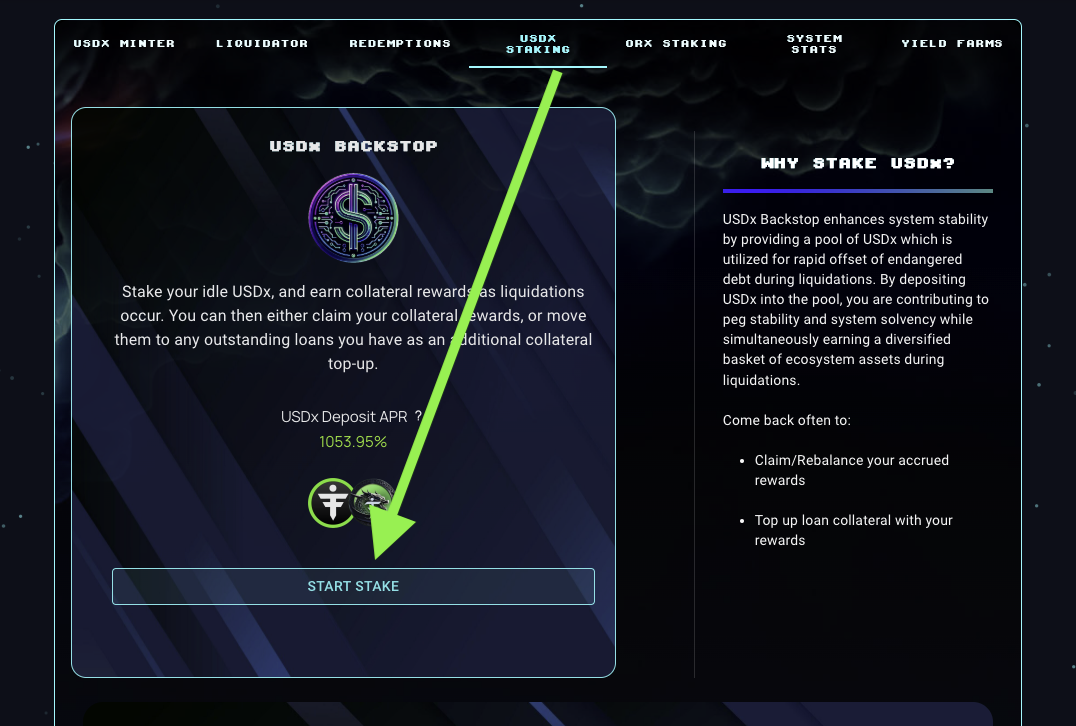
<div data-full-width="false"><figure><img src="https://754022034-files.gitbook.io/~/files/v0/b/gitbook-x-prod.appspot.com/o/spaces%2FGBrM5XVsj4G0P2rkCSG1%2Fuploads%2FEWBbrtxH36i6Gi4hDLe5%2FScreenshot%202025-01-29%20at%2018.54.11.png?alt=media&amp;token=4100feda-dc30-4864-910d-f1ac19462d10" alt=""><figcaption><p>Deposit to the Backstop Pool by going to the "USDX STAKING" tab, and clicking START STAKE</p></figcaption></figure></div>

To stake your USDx, simply go to the USDX STAKING tab, click START STAKE, and enter the amount of USDx you would like to provide.  Once your transaction is confirmed, you will see your participation stats.&#x20;

<figure><img src="https://754022034-files.gitbook.io/~/files/v0/b/gitbook-x-prod.appspot.com/o/spaces%2FGBrM5XVsj4G0P2rkCSG1%2Fuploads%2FYgskFYPYOa0zRa3G3BjH%2FScreenshot%202025-01-29%20at%2019.04.35.png?alt=media&amp;token=a8d09ac8-4ed6-4593-82b1-4576ba8cf5aa" alt=""><figcaption></figcaption></figure>

After your deposit is complete, we can observe the following stats...

<figure><img src="https://754022034-files.gitbook.io/~/files/v0/b/gitbook-x-prod.appspot.com/o/spaces%2FGBrM5XVsj4G0P2rkCSG1%2Fuploads%2FcYPBRZv0x9nnaAyOSeps%2FScreenshot%202025-01-29%20at%2019.03.56.png?alt=media&amp;token=c18205e1-e701-41e2-b549-77569e88e448" alt=""><figcaption></figcaption></figure>

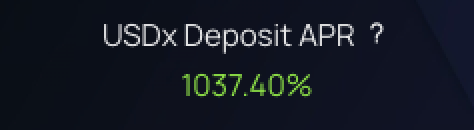
* **USDx Deposit APR:** The APR of ORX inflationary rewards for providing to the liquidation pool
* **Current Stake:** The current amount of USDx you have staked within the Backstop Pool.  **This figure reduces each time a liquidation occurs.**&#x20;
* **Pool Share:** Your share of the Backstop Pool.  This figure is important to know, as liquidation rewards are divided out according to your share within the pool.  In other words, if you occupy 50% of the pool, then you will contribute 50% of the USDx toward liquidating a position, and get a 50% share of the liquidated rewards.&#x20;
* **Yield:** Your currently accrued ORX rewards.  This number increases every-time a user interacts with the pool, rather than on a timed basis.  You need to claim your ORX to start the vesting process, which follows the same schedule as TitanX deposits to the ORX Minter. &#x20;

### A Practical Example of a Liquidation Reward

Let’s say there is a total of 1,000,000 USDx in the Stability Pool and your deposit is 100,000 USDx.

Now, if we assume an MCR/Liquidation Ratio of 110% for TitanX, a Position with a debt of 200,000 USDx, collateral of 615,000,000,000 TitanX, and a current TitanX price of $0.000000355, we can observe that this position has a current collateral ratio of 109%\~, and is thus liquidated.

(100 \* (615,000,000,000 \* 0.000000355) / 200,000) == 109%

Given that your pool share is 10%, your deposit will go down by 10% of the liquidated debt (20,000 USDx), i.e. from 100,000 to 80,000 USDx. In return, you will gain 10% of the liquidated collateral, i.e. 61,500,000,000 TitanX, which is currently worth approx $21,800\~. Your net gain from the liquidation is $1,800.

Note that you can immediately withdraw the collateral received from liquidations and sell it to reduce exposure to the underlying collateral, if the USD value of the collateral is expected to decrease.  The only exception to USDx withdrawals, is that they are not possible while there are pending Positions to liquidate. &#x20;

### How are Inflationary ORX Rewards Paid Out?

Firstly, they must be activated.  You will know if these rewards are activated, since the APR figure will be displayed above the collateral icon list

<figure><img src="https://754022034-files.gitbook.io/~/files/v0/b/gitbook-x-prod.appspot.com/o/spaces%2FGBrM5XVsj4G0P2rkCSG1%2Fuploads%2Fk5FbAv6cssWPDxdXdVEX%2FScreenshot%202025-01-30%20at%2013.59.24.png?alt=media&amp;token=6f69bb61-3402-4b6b-9979-0a16a5c7599f" alt="" width="237"><figcaption></figcaption></figure>

While activated, every depositor in the BackstopPool will earn ongoing ORX inflationary rewards, at every pool touchpoint.  As other users interact with the pool, your ORX rewards will increase.  **In order to claim these rewards**, you are required to do one of the following:&#x20;

1. Interact with the pool by withdrawing/depositing USDx
2. Manually claiming via the 'Claim Rewards' button.&#x20;

<figure><img src="https://754022034-files.gitbook.io/~/files/v0/b/gitbook-x-prod.appspot.com/o/spaces%2FGBrM5XVsj4G0P2rkCSG1%2Fuploads%2FWAopcWSn37smfiv7q8D0%2FScreenshot%202025-01-30%20at%2014.02.41.png?alt=media&amp;token=f904bf4b-f80d-43d8-ac5e-1d7cc4c8894d" alt="" width="375"><figcaption><p>Either Adjust, Exit, or 'Claim Rewards' your stake to claim ORX</p></figcaption></figure>

Once claimed, your ORX rewards will be vested in the exact same manner as those given out for TitanX deposits into the ORX Minter.  You can understand these unlock mechanics by checking the  [Launch/Participation Mechanics](/the-ouroboros-usdorx-token/launch-participation-mechanics#vesting-schedule-and-evfs) page.  ORX earned via Yield Farming, will be displayed as such.  To minimise gas costs, consider claiming ORX rewards at fixed intervals, rather than at every available opportunity.&#x20;

<figure><img src="https://754022034-files.gitbook.io/~/files/v0/b/gitbook-x-prod.appspot.com/o/spaces%2FGBrM5XVsj4G0P2rkCSG1%2Fuploads%2FREgThnCqiUGzEMtYNIdw%2FScreenshot%202025-01-30%20at%2013.53.03.png?alt=media&amp;token=4fd3d421-001d-4f36-9dd2-436c80ed0c2a" alt=""><figcaption></figcaption></figure>

<figure><img src="https://754022034-files.gitbook.io/~/files/v0/b/gitbook-x-prod.appspot.com/o/spaces%2FGBrM5XVsj4G0P2rkCSG1%2Fuploads%2FeVI5OUMH2XV6SDt9cjFL%2FScreenshot%202025-01-30%20at%2017.42.29.png?alt=media&amp;token=82229cb5-e92d-4bf0-9e7f-64a9ffa453f1" alt="" width="558"><figcaption><p>Each time you claim Yield Farmed ORX, it will enter its own individual vesting curve.</p></figcaption></figure>

### Summary

Participating in the liquidation process, in any form, offers an attractive mix of direct, passive, and real yield rewards.  It is not however, a fully *passive* form of yield.  When participating in the BackstopPool, check back often to ensure that the particular mix of earned collateral, and USDx deposits, matches your desired exposure profile, and recompound rewards often to lock in more stable value for your portfolio.


# 4. Redemptions & How the Peg Holds

A description of the redemption process for USDx, and how the peg holds in general under various circumstances.

The USDx Stablecoin features a set of what are called *soft & hard pegging mechanics. Hard* mechanics are a set of behaviours which can result in immediate price action which restores the peg.  *Soft* mechanics are those which may or may not present themselves, but which have a slight economic incentive to appear.&#x20;

* Soft Peg Mechanics
  * **A $1 Schelling Point:** The more time USDx spends around $1, the more it will be commonly accepted that it is capable of staying around this price point.  As a result, the implied value of USDx will be front of mind when encountering things like slippage, and as a result people will be less willing to sell below $1, or buy above $1.
  * **USDx above $1:** Users begin taking more debt, to secure a premium when using USDx for leverage (Higher USDx price means more of the leveraged asset can be purchased per unit)
  * **USDx below $1:** Users buying cheap USDx to pay off debt
* Hard Peg mechanics
  * **USDx&#x20;*****significantly*****&#x20;above $1:** Take out debt to sell USDx back to $1, at such a high value that even an immediately liquidated position presents a profit.
  * **USDx below $1:** Buy USDx at a discount on market, and redeem for $1 worth of collateral per unit

The loaning feature has already been covered in [2. Your First Loan & What to Monitor While your Loan is Open](/ouroboros-products/usdx-stablecoin/educational-track/2.-your-first-loan-and-what-to-monitor-while-your-loan-is-open), so for this article, we will talk about the Redemption process, how you can participate in it, and also some of the nuances regarding the Redemption Escrow functionality.&#x20;

### Redeeming your USDx for Collateral

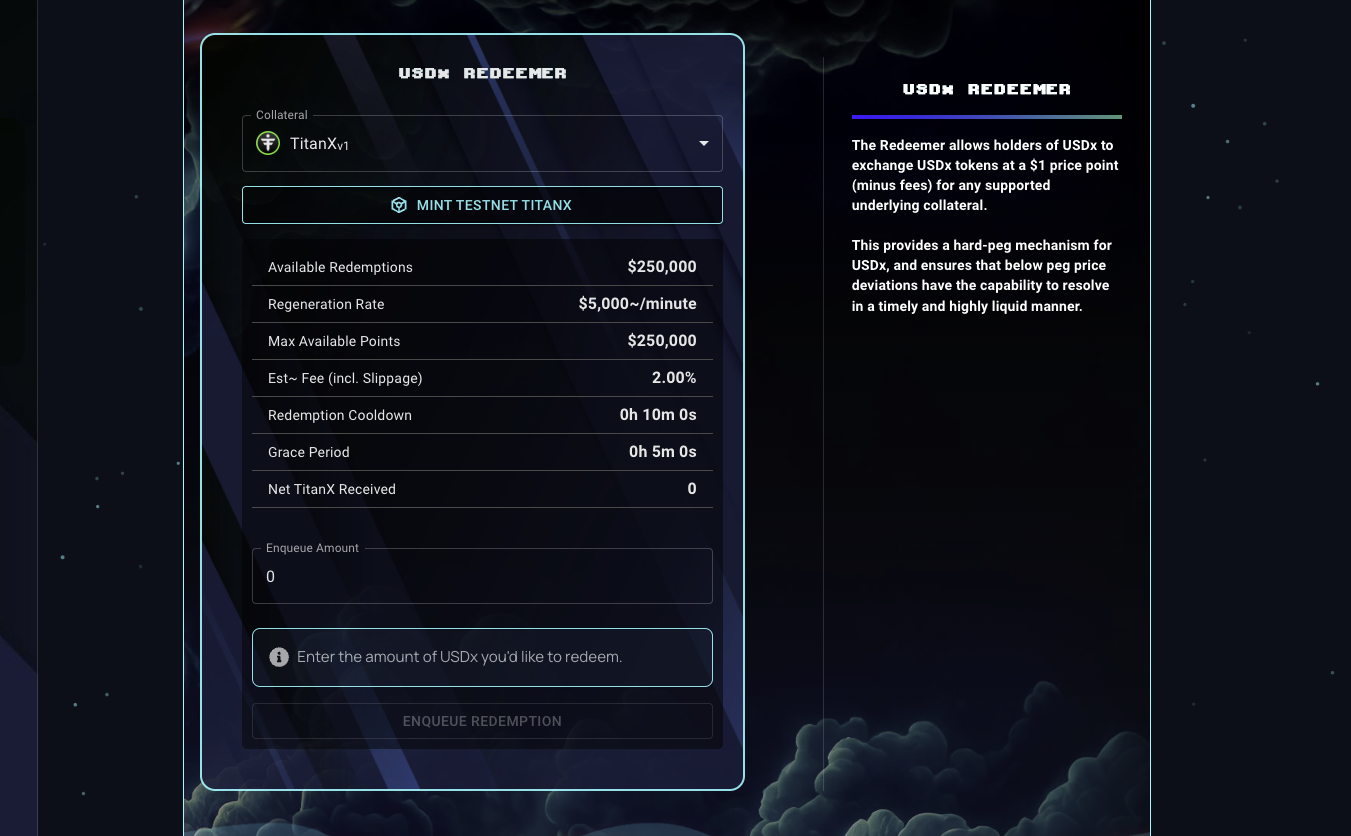
<figure><img src="https://754022034-files.gitbook.io/~/files/v0/b/gitbook-x-prod.appspot.com/o/spaces%2FGBrM5XVsj4G0P2rkCSG1%2Fuploads%2FFzlRDHky3EAvFEB03mWD%2FScreenshot%202025-01-30%20at%2018.22.21.png?alt=media&amp;token=ec88b58e-a57a-4bd3-acf5-dcd4fd1c311d" alt=""><figcaption><p>The redemptions UI @ <a href="https://ouroboros.foundation/usdx#/redemptions">https://ouroboros.foundation/usdx#/redemptions</a></p></figcaption></figure>

#### The Setup

A whale has taken a large loan, and chooses to ignore slippage when trading their loaned USDx for another asset.  As a result, the price of USDx drops to 90c.  You are a savvy user, and compete with other savvy users to buy this below peg USDx.  You manage to purchase $10,000 worth of USDx before price rebounds to 98c, and end up with 10,700 USDx units.

You now opt to lock in the arbitrage profit from your purchase, by redeeming 10,700 USDx units, for $10,539.5 worth of Collateral.  There is a slight loss in profit here, as we assume a 1.5% redemption fee applied to the redemption.&#x20;

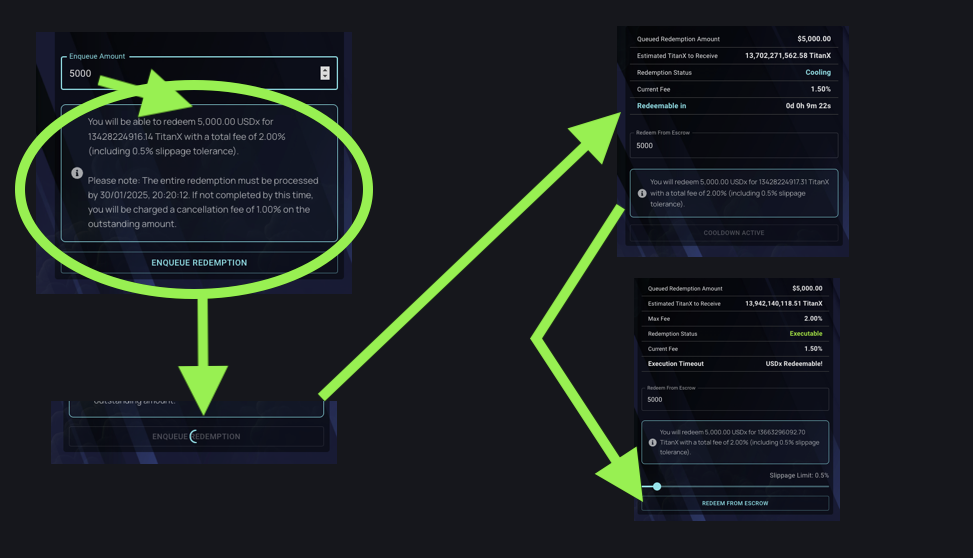
#### Mechanics of Performing the Redemption, and the Redemption Escrow.&#x20;

For most collaterals, it is required to pass through an escrow process during the redemption.&#x20;

1. Escrow USDx until the **Redemption Cooldown** period has elapsed
2. Complete your escrow by redeeming all queued USDx before the **Grace Period** causes a timeout
3. If you fail to complete your redemption in time, you will be charged the *Redemption Timeout Fee,* which is configured on a per collateral basis.  Typically, it will be 1%.

<div data-full-width="true"><figure><img src="https://754022034-files.gitbook.io/~/files/v0/b/gitbook-x-prod.appspot.com/o/spaces%2FGBrM5XVsj4G0P2rkCSG1%2Fuploads%2F2DhFuHPgYp19sNfjXbZ5%2FScreenshot%202025-01-30%20at%2020.09.10.png?alt=media&amp;token=1ad155a2-fd2a-44cb-b8b8-5a1fdc55c460" alt=""><figcaption><p>Click to Zoom, and read detailed information</p></figcaption></figure></div>

### Redemption Caveats

When performing a redemption, **it is not always guaranteed that execution will be successful**.  The minimum debt possible in the USDx system is 1800 USDx.  Positions which are smaller than this, must be closed by the redemption completely, otherwise, the redemption attempt is cancelled.  Positions which are larger, are capable of being *partially redeemed* by the redemption.  Since redemptions happen in order from least collateralised to most collateralised, this means that there is a chance that the loan at the front of the redemption queue, and your total redeemable amount which is queued, do not match up in a way which allows the redemption attempt to complete gracefully.  This results in a cancelation, and your queued USDx may sit in limbo until the grace period expires.&#x20;

Thankfully, this worst case scenario is limited to a lower bound; it presents itself when the queued amount of USDx is relatively small, and the loan at the front of the redemption ordering is small.  As a result, any potential 'unfairly' applied fees, should only be applied to an amount less than $2000.  **However, still keep in mind that for smaller USDx redemption amounts, it may be a good idea to inspect the loan at the head of the queue, to ensure that your redemption amount is either sufficiently large to close the loan completely, or that the loan itself is large enough to absorb your redemption without falling below the minimum debt requirement of 1800 USDx.**&#x20;

### Summary

The redemption process opens up an incentive for buying USDx below $1, and ensures that so long as the global/total collateral ratio of the system stays above 100%, that USDx can hold its peg.  In addition, the redemption process opens up an attractive arbitrage opportunity which helps to stabilise the protocol, and reward watchful/active users.  So long as redemption sizing is managed carefully to avoid paying fees unnecessarily, users can participate as active guardians of the USDx peg, and earn a profit for doing so.&#x20;


# 5. Closing Summary & Cheatsheet

A super condensed closing summary on each of the previously presented topics.

### **Summary**

Understanding the previous series of articles will make you an advanced beginner, or even intermediate user of USDx and other systems like it, before the platform is even launched.  You can now safely participate in the protocol, with a full view of what to monitor, and how to participate most effectively given the particular angle you wish to approach the system from.&#x20;

### **USDx Users & What They Care About**&#x20;

USDx serves four main user types, each with distinct priorities:

* **USDx Traders:** Use it as a stable store of value, focus on liquidity and peg stability
* **USDx Leverage Traders:** Use loans to amplify gains, monitor liquidation levels and redemption risk to maintain collateral exposure
* **USDx Yield Speculators:** Focus on yield opportunities through LP rewards and Backstop Pool
* **USDx Arbitrageurs:** Capitalize on peg deviations and liquidation opportunities

### Your First Loan & What to Monitor&#x20;

Loan management is central to USDx:

* **Minimum collateral requirement:** $2,500 worth
* **Key metrics:** Liquidation Price, Safety Buffer, MCR/CCR ratios
* **Monitor three main risks:** Redemptions, Liquidation Risk, Recovery Mode
* **Keep loan health above CCR (150%) for maximum safety**
* Watch redemption queue position to maintain collateral exposure

### Liquidations & USDx Staking Rewards&#x20;

The Backstop Pool is a key source of system health and rewards:

* Pool holds USDx for liquidations
* Rewards include ORX inflation and discounted collateral rewards during liquidations
* **Liquidator reward:** 200 USDx + 0.5% of collateral for pressing a button
* ORX Rewards vest like TitanX deposits in ORX Minter
* Compound your USDx regularly, as the amount of USDx you deposit is not a static entity, and will be changed by liquidations!

### Redemptions & Peg Mechanics&#x20;

Peg stability maintained through multiple mechanisms:

* **Soft pegging:** Natural market forces and $1 Schelling point
* **Hard pegging:** Profitable arbitrage opportunities above/below $1
* Redemption process includes escrow period
* Failed redemptions possible if loan sizes don't align
* Redemptions progress from least to most collateralized loans
* Buy USDx below $1, and profit.&#x20;


# Risk Disclosure

#### **Dependencies** <a href="#dependencies" id="dependencies"></a>

* Oracles: Chainlink for ETH/USD, UniswapV3 TWAP Oracles for TitanX and DragonX

#### Chain Risk <a href="#chain-risk" id="chain-risk"></a>

* Deployment chain: Ethereum Mainnet
* Cross-chain: none at launch (native to Mainnet and no cross-chain risks)

While USDx itself is native to Ethereum, it may eventually be supported by a cross chain messaging solution like LayerZero.

#### **Smart Contract Risks** <a href="#smart-contract-risks" id="smart-contract-risks"></a>

USDx has no manual pause, freeze, or shutdown functions. However, the protocol is capable of initiating an automatic shutdown of a collateral in case of an extreme price change of the respective collateral asset, or an oracle failure of that particular collateral asset.

* See our audits for more information: Pashov Audit Group, Hunter Sec
* Pause function: none
* Protocol freeze function: none
* Protocol temporary circuit breaker: If Uniswap V3 TWAPs diverge significantly
* Protocol shutdown function: Yes, it would be algorithmically targeted towards a specific collateral if the price of ETH/USD moves by more than 20%.  A guardian will then manually verify that this was a valid or invalid price movement.
* whitelist or blacklist: whitelistable redemptions are possible
* transfer freeze functionality: none

#### Collateral Risk <a href="#collateral-risk" id="collateral-risk"></a>

* Collaterals assets accepted: TitanX, DragonX, with possible extensions pending timelocks and a multisig
* Collaterals assets accepted within the protocol are non-upgradeable and cannot be changed

**What’s the shared-collateral risks?** Each supported collateral asset constitutes an individual borrow market with its own group of borrowers and a unified Stability Pool backing their debts. This separation impacts user groups differently:

* Borrowers: Collateral risk is limited to the collateral asset held by the borrower. A borrower isn’t negatively affected by a failure of another collateral asset.
* USDx Holders: As a multi-collateral stablecoin, USDx is reliant on effective liquidations of undercollateralized loans in every borrow market to remain overcollateralized. Holders are subject to the risks of all supported collateral assets.
* Backstop Pool depositors get exposure to all supported system assets. However, as USDx holders, they are similarly affected by potential depegging.

**Are there any safety mechanisms in place for potential de-pegs of the underlying collateral asset?** The protocol aims to protect each borrow market from becoming undercollateralized by throttling debt creation and collateral withdrawal in unhealthy markets and by shutting down the entire market as a last resort. There are two safety thresholds:

#### Oracle Risk <a href="#oracle-risk" id="oracle-risk"></a>

If Chainlink oracles fail, collateral markets might get priced inaccurately, leading to unfavorable redemptions or excessive or delayed liquidations. Oracle staleness could also cause problems by using out-of-date prices during shutdowns, leading to improper liquidations or redemptions.

#### Infrastructure Risk <a href="#infrastructure-risk" id="infrastructure-risk"></a>

* Onchain infrastructure: None other than Infura nodes (transactions could get delayed or dropped) None for on-chain functionality.

#### Governance and Economic Risk <a href="#governance-and-economic-risk" id="governance-and-economic-risk"></a>

* Core protocol: is immutable - nothing can be upgraded
* Upgradable code: none
* Updatable parameters: redemption rates, loan rates, debt caps, MCR/CCR (after timelock and multisig), collateral list.  See `CollateralController` contract for full list.&#x20;
* Timelocks: 3 day timelock for new collateral inclusion, 1 day timelock for all critical administrative tasks
* ⅔ gnosis multisig is responsible for collateral setting updates

**Bad Debt mitigation and Shutdown:** In extreme cases, such as a severe drop in collateral value or failure of a supported collateral, the system may become undercollateralized. This could lead to the shutdown of a specific collateral, and the remaining debt could become "bad debt"—unbacked by sufficient collateral. This could in the worst case lead to bank runs: a portion of the system debt can not be cleared, and hence a portion of the USDx supply can never be redeemed.

#### Liquidity Risk and Liquidations <a href="#liquidity-risk" id="liquidity-risk"></a>

Potential risk: There's no guarantee that the liquidation gains are actually gains. In the worst case, e.g. when the oracle lags behind or a collateral flash-crashes within a few blocks, the gains could turn into losses.  USDx tries to minimise this by using a weighted average price for the liquidation price, which is 'pullable' by 10% based on a short term TWAP.&#x20;

**Redemption mechanism and risk for USDx Stability**

To prevent USDx from falling below $1, the platform includes a redemption mechanism. Any USDx holder can redeem 1 USDx for $1 worth of collateral, ensuring that USDx remains pegged to its intended value. Redemptions are prioritized by the lowest health Positions first. Importantly, redemptions do not result in a net loss for borrowers but ensure the peg remains intact.

**Liquidation Process**

In the event of liquidations, the system first looks to the Backstop Pool. If the Pool contains sufficient USDx, it burns an amount equivalent to the borrower’s debt and redistributes the borrower’s collateral  to the Pool’s depositors. These depositors receive collateral, proportional to their deposits.

If the Backstop Pool is depleted and cannot cover the entire debt, the system falls back on two other liquidation modes:

* Just-in-Time (JIT) Liquidation: A liquidator deposits the amount of USDx needed to cover the remaining debt directly into the Backstop Pool, immediately triggering liquidation
* Redistribution Mode: If JIT liquidation is not chosen, the entire debt and the MCR% of it in collateral is redistributed to fellow borrowers who hold the same type of collateral. Their debt increases proportionally, but they also receive a share of the liquidated collateral, ensuring system-wide balance.

This multi-layered liquidation process ensures that each collateral market is isolated from the others, minimizing systemic risk and allowing users to manage their positions independently.

#### MEV Risks <a href="#mev-risks" id="mev-risks"></a>

**Frontrunning risk:** Borrowers may attempt to evade redemptions by either adjusting their Positions health or closing and reopening their Position. This "frontrunning" could occur when the USDx price falls below $1, as savvy borrowers try to protect their positions from redemptions that would otherwise target them based on their health. Both “hard” frontrunning (directly from mempool observations) and “soft” frontrunning (reacting to the USDx peg) could negatively affect redemption efficiency and system stability, while also unfairly affecting borrowers that are playing by the rules.

**Mitigation:** Two fees are applied to disincentivize this behavior:

1. Upfront Borrowing Fee: Charged when a borrower opens a Position or increases its debt. By applying this fee, borrowers are discouraged from continually closing and reopening Positions to evade redemptions, as it increases the cost of frequent adjustments.
2. Redemption and Loan Escrows: When loans are opened on volatile assets with lagging TWAPs, a loan escrow is enacted, which is also matched with a redemption escrow.  This makes risk free front running of lagging price updates much more difficult, shifting the usually risk free actions of MEV to moreso a trading style risk equation, where uncertainty is created to disincentivise dishonest actions.&#x20;

These measures help ensure that borrowers cannot easily front-run system redemptions, while also making oracle update front runs on redemptions more difficult.&#x20;


# Contract Addresses

List of contract addresses for Core USDx, Periphery Contracts, and Collateral Instance Contracts.

### Core USDx/ORX Contracts

#### ORX Minting Contracts

Contracts with explicit mint rights over ORX

| Contract                         | Address                                                                   |
| -------------------------------- | ------------------------------------------------------------------------- |
| ORX                              | <https://etherscan.io/address/0xd536E7A9543Cf9867a580B45CEC7F748a1FE11eC> |
| Backstop Pool Incentives         | <https://etherscan.io/address/0x91804513f407aaD860968F59A4a8bdE12E71b9b1> |
| UniV2 USDx/ETH Farm (deprecated) | <https://etherscan.io/address/0x429E4593Ef49477894a694f332B0d6515d066A55> |
| ORX Minter                       | <https://etherscan.io/address/0x4C93D6380D22C44850Bdfa569Df5dD96e278622B> |

#### USDx Core Contracts

Contracts which coordinate common actions among all Collaterals: Liquidations, Stablecoin mint rights, Collateral management operations, Loan operations, Fee sharing...

| Contract                               | Address                                                                   |
| -------------------------------------- | ------------------------------------------------------------------------- |
| USDx                                   | <https://etherscan.io/address/0xDDF73eAcB2218377FC38679aD14dfce51B651Dd1> |
| Collateral Controller (Timelock)       | <https://etherscan.io/address/0x1E7460c8527282fd15b4bC7bBC451Cd20d95b14E> |
| Backstop Pool                          | <https://etherscan.io/address/0x11Be18370B2937E011Fd5c853f5B9aEEa797Fd54> |
| Gas Compensation Pool                  | <https://etherscan.io/address/0x5F01015f80552397455deEa35Eea78E1b1f71BCc> |
| Position Controller                    | <https://etherscan.io/address/0xad29b3738EA37F1EB8a8F6745aEef51399fCE57B> |
| Revenue Sharing / ORX Staking          | <https://etherscan.io/address/0xE293DFD4720308c048B63AfE885F5971E135Eb1e> |
| Collateral Controller (Implementation) | <https://etherscan.io/address/0x5b6b35fb15f08c3232934ed37ba8746103cb8896> |

#### USDx Periphery Contracts

Contracts not directly related to the running of USDx, but which feed parts of the UI.&#x20;

|                            |                                                                                                                                                    |
| -------------------------- | -------------------------------------------------------------------------------------------------------------------------------------------------- |
| Hint Helpers               | <https://etherscan.io/address/0x9E4f649B44f062EEf0e7C5bd23eBE72261165B51>                                                                          |
| Multi Position Getters     | <https://etherscan.io/address/0xf9Ba7B5a604A5cbcE3B95364645a692e5A7f6361>                                                                          |
| Weighted Redemption Module | h[ttps://etherscan.io/address/0xfb3B213E9933E9a8DCE659FC47cf02de441908de](https://etherscan.io/address/0xfb3B213E9933E9a8DCE659FC47cf02de441908de) |

### Collateral Instance Contracts

Contracts which belong to particular deployments of supported collaterals.  NOTE: Although collaterals will often share common contract names, it is **not guaranteed that all collaterals will share a common implementation for the same contract name.**&#x20;

Different collaterals may require specific token or collateralisation handling logic.

#### wETH

|                         |                                                                           |
| ----------------------- | ------------------------------------------------------------------------- |
| Oracle                  | <https://etherscan.io/address/0xf50e40ff2a6a7267b9a33e71ee0c1b62f015af9b> |
| Sorted Positions        | <https://etherscan.io/address/0xc68eb2821b9f3923a977328e8adb8ff74076921e> |
| Active Pool             | <https://etherscan.io/address/0x7b14092ccbf9273bca5bf2e356f2260e34284e3e> |
| Default Pool            | <https://etherscan.io/address/0xaef49db056ced92ede8bc7e73b299f8dfc14026f> |
| Collateral Surplus Pool | <https://etherscan.io/address/0xc76e62d7336b35f8552fe109f834ca2413833024> |
| Position Manager        | <https://etherscan.io/address/0x46b3bb543f332dba73407e086da660ee0cff410b> |
| Liquidation Manager     | <https://etherscan.io/address/0x1459E167b1567687646aA5E0434DD9A9F6d023eF> |

#### TitanX

|                         |                                                                           |
| ----------------------- | ------------------------------------------------------------------------- |
| Oracle                  | <https://etherscan.io/address/0xe24794da9035EB0b6d8739369ECd894faFD9A09F> |
| Sorted Positions        | <https://etherscan.io/address/0x07C2246430A7b50B0670ab184E3b871e073D757B> |
| Active Pool             | <https://etherscan.io/address/0xd8291316C82F3979ecff4f1113e93caA0a2f4749> |
| Default Pool            | <https://etherscan.io/address/0x979aAB4f159949c7dc44Df49f696B9b72874068F> |
| Collateral Surplus Pool | <https://etherscan.io/address/0xC42f8b78d1fD73574F138ADCEA99ECAA1A29AB2b> |
| Position Manager        | <https://etherscan.io/address/0xbDF40716ccdE569914668ee4a05dc5703deE97d4> |
| Liquidation Manager     | <https://etherscan.io/address/0xd7c0551130606a8e513e65a2e266a66b5df21c4b> |

#### DragonX

|                         |                                                                           |
| ----------------------- | ------------------------------------------------------------------------- |
| Oracle                  | <https://etherscan.io/address/0x9d8C056E503Bb5d1206c3AA36B71F3d15589962F> |
| Sorted Positions        | <https://etherscan.io/address/0xBe5ef1183732D374F2d4f229333EeA9A0cD4F5B9> |
| Active Pool             | <https://etherscan.io/address/0xeC8CEdF0b25BB6B6DE492B9Ed702A76E0503Af8E> |
| Default Pool            | <https://etherscan.io/address/0xd6AE358f8BD4001e264d81020ddCB4eEe794B154> |
| Collateral Surplus Pool | <https://etherscan.io/address/0x855866eaf136d942cF3e72Be9ffdea66453d5fFe> |
| Position Manager        | <https://etherscan.io/address/0x562A80aeC9310d6276DC01c63244bCD19d3bC27d> |
| Liquidation Manager     | <https://etherscan.io/address/0xcd05822a348350be84d1b865f1bb3f2b0cf27172> |


# Audits

PDF Reports for audit work carried out on the USDx codebase.

3.5 auditor-weeks supplied by HunterSec

{% file src="/files/E4GwNChP9JRyqdlwR6TJ" %}

A further two long duration audits were carried out by industry leading auditors: <https://x.com/PashovAuditGrp>, with a mix of several expert auditors in general security, and a few stablecoin/lending specialists.  6 weeks of total audit time over two distinct audit phases.&#x20;

{% file src="/files/NVHOWT3gwRKdu13lSlpv" %}

Redemption splitter module and wETH Oracle audit comprised of 4 auditors over 3 days.

{% file src="/files/TlUYKv2TqLNBQp37c4R8" %}


# Universal Staking Module

Staking and Protocol Owned Liquidity Plugin for Ouroboros

<figure><img src="https://754022034-files.gitbook.io/~/files/v0/b/gitbook-x-prod.appspot.com/o/spaces%2FGBrM5XVsj4G0P2rkCSG1%2Fuploads%2FjxWFX0WrPLEWdwcMC03i%2FScreenshot%202025-09-19%20at%2022.50.36.png?alt=media&amp;token=92b6e8a2-8a0d-4262-85b4-59fd64edcfc9" alt=""><figcaption></figcaption></figure>

## Introduction&#x20;

The **Universal Staking Module (USM)** is a comprehensive suite of smart contracts which impact how liquidity provision and token staking are managed across Uniswap V3 and ERC20 assets within Ouroboros deployments. It unifies multiple staking paradigms into a single, cohesive system while maintaining the flexibility demanded by modern DeFi protocols.

### **Core Architecture**

The Universal Staking Module consists of three primary components:

**1. UniswapV3 Enhanced Staker** - A sophisticated NFT position management system that extends standard Uniswap V3 staking with advanced features including protocol-owned liquidity (POL) mechanics, restricted tick ranges, and dual reward accrual mechanisms to cater for contested and non-contested liquidity setups.

**2. ERC20 Staking Manager** - A versatile staking platform for standard ERC20 tokens, supporting both locked and unlocked incentive structures with flexible reward distribution schedules.

**3. Emission Controller** - A unified reward distribution engine that handles complex vesting schedules, including dripped rewards and exponentially vested rewards.  Both types can include forfeitable claims, along with staged mint cycles, and time delayed initial unlocks.&#x20;

### **Key Usecases for Ouroboros**

<div data-full-width="false"><figure><img src="https://754022034-files.gitbook.io/~/files/v0/b/gitbook-x-prod.appspot.com/o/spaces%2FGBrM5XVsj4G0P2rkCSG1%2Fuploads%2FLRN80fSXAKdAjk7eiR1q%2FScreenshot%202025-09-19%20at%2023.00.46.png?alt=media&amp;token=31433ccb-5da5-41db-ae4d-8cf22d1cda8b" alt="" width="375"><figcaption></figcaption></figure></div>

**Protocol-Owned Liquidity (POL)** - Positions can be designated as permanent protocol liquidity, creating a guaranteed liquidity base that strengthens protocol stability and reduces mercenary capital risks.

**Dual Reward Accrual Mechanisms to Target Existing LP setups** - Support for both traditional liquidity-weighted rewards and share-weighted distribution models, allowing protocols to optimize for different user behaviors and market conditions.  This allows the targeted incentivisation of protocol owned liquidity formation against pre-existing locked liquidity pools, or the creation of newly formed full range liquidity pools for the purposes of constructing reliable onchain oracles.&#x20;

**Addition of Time Locked Incentives for ORX -** brings additional yield sources to ORX

## Types of Locked Stakes

Incentives offer a variety of configuration and participation settings.  Most of these will allow users to enter and exit stakes at will, but some, will ***only allow users to enter,*** and then exit at either a predefined, or undefined future date.&#x20;

#### ERC20 Locked Stakes

In the context of ERC20 single asset stakes, locked incentives are marked as 'Time Locked' on the incentive card.  Once staked into those incentives, a user must serve the full term of the stake.

<figure><img src="https://754022034-files.gitbook.io/~/files/v0/b/gitbook-x-prod.appspot.com/o/spaces%2FGBrM5XVsj4G0P2rkCSG1%2Fuploads%2FPOhoUeBYjKhGAZAOfzbh%2FScreenshot%202025-09-20%20at%2013.19.38.png?alt=media&amp;token=91059e2e-7c84-4817-87ec-96771f955cf7" alt=""><figcaption></figcaption></figure>

To know when the term ends, you can either look at the timeline component to see time remaining, or hover over the bar to see the exact end date.  Critically, users do not decide the terms of the lockup.  A user who locks half way through the incentive duration, will be locked for half the time as those who locked on day 1, but receive half the rewards.&#x20;

<figure><img src="https://754022034-files.gitbook.io/~/files/v0/b/gitbook-x-prod.appspot.com/o/spaces%2FGBrM5XVsj4G0P2rkCSG1%2Fuploads%2FXb0o5cEjyRcjd76xPPPx%2FScreenshot%202025-09-20%20at%2013.24.46.png?alt=media&amp;token=919f981b-2575-4211-9af9-d263c9f208a8" alt=""><figcaption></figcaption></figure>

#### UniswapV3 Protocol-Owned-Liquidity Incentives

In the context of LP stakes, locked incentives are marked as 'POL' on the incentive card.  Once a liquidity NFT is staked in a POL incentive, **it cannot be withdrawn from the platform until explicitly released.** &#x20;

<figure><img src="https://754022034-files.gitbook.io/~/files/v0/b/gitbook-x-prod.appspot.com/o/spaces%2FGBrM5XVsj4G0P2rkCSG1%2Fuploads%2FW0tEo9dCALP9oPDvPsWK%2FScreenshot%202025-09-20%20at%2013.38.26.png?alt=media&amp;token=5aaf03e0-edc0-45f0-9cd3-c1fe8a2e47c6" alt=""><figcaption></figcaption></figure>

### **Important Considerations for POL/Locked liquidity NFTs**

1. **You should assume that the duration of the lock is indefinite.  The facility to release the lock, is largely so that users can reclaim their tokens in the event that they are no longer needed by the platform OR for the case where USDx locked in a liquidity pool, is needed for some other purpose.**
2. **POL Incentives are likely for stable asset pairs, but in the event that a volatile pair is listed, please be mindful that if those tokens are eventually released, you will not receive the same amount of each back due to Impermanent Loss (IL).**
3. Most if not all locked liquidity incentives, will fall into well defined ranges.  However, in the unlikely event that an open ended incentive is created from a liquidity range point of view, please be aware that if your provided NFT falls out of range of the active liquidity on UniswapV3, it may not earn rewards or trading fees.&#x20;

### **Key Summary of Locked Incentives**

1. **Single Asset stakes must serve their full term, and will be automatically released after.**
2. **Liquidity NFTs become permanently locked, but can move between incentives within the platform.**
3. **Liquidity NFTs can be released from the platform at a future date.  This becomes particularly nice if the supplied NFT contains a stable pair, as it may act as a type of savings account for the user.**

### **ERC20 Staking System**

<figure><img src="https://754022034-files.gitbook.io/~/files/v0/b/gitbook-x-prod.appspot.com/o/spaces%2FGBrM5XVsj4G0P2rkCSG1%2Fuploads%2FMMMLxLqVJvM7iOiNH0lN%2FScreenshot%202025-09-19%20at%2023.47.45.png?alt=media&amp;token=c5b09051-a939-43ed-b159-478081aae365" alt=""><figcaption></figcaption></figure>

The ERC20 Staking Manager enables protocols to create targeted incentive programs for any standard token. Stakers deposit their tokens into specific incentive pools where rewards accumulate continuously based on their proportional share of the total staked amount. Each incentive operates independently with its own reward token, duration, and distribution parameters, allowing multiple programs simultaneously for different user segments or strategic goals.

**Key Features:**

* **Flexible Lock Mechanisms** - Choose between freely withdrawable stakes or time-locked commitments with enhanced rewards
* **Multiple Emission Styles**:
  * Regular - Instant transfer upon claiming
  * Dripped - Linear release over specified period
  * Vested - Exponential release
  * Staging Periods - Optional delay between claiming and receiving rewards
  * Forfeitable Allocations - One-shot emissions returning unclaimed rewards after first claim
* **Grace Period Protection** - Configurable window after program ends before creators can reclaim funds
* **Refundee System** - Automatic return of unclaimed rewards to designated address

### **Uniswap V3 Staking System**

<figure><img src="https://754022034-files.gitbook.io/~/files/v0/b/gitbook-x-prod.appspot.com/o/spaces%2FGBrM5XVsj4G0P2rkCSG1%2Fuploads%2FmxllZsGEmQK0UX3Icjzp%2FScreenshot%202025-09-19%20at%2023.47.58.png?alt=media&amp;token=ed3e0a92-b343-478d-8392-f83e09239bcf" alt=""><figcaption></figcaption></figure>

The enhanced Uniswap V3 Staker manages liquidity NFT positions with unprecedented control over where and how liquidity is deployed. Liquidity providers stake their position NFTs to earn rewards while maintaining the ability to collect trading fees and adjust liquidity amounts. The system supports sophisticated requirements around tick ranges, position widths, and permanence, enabling protocols to precisely target liquidity where it's needed most while rewarding providers based on either their time-in-range performance or their simple share of total liquidity.

**Key Features:**

* **Dual Reward Mechanisms** - Liquidity-weighted (rewards for in-range time) or Share-weighted (flat distribution)
* **Protocol-Owned Liquidity (POL)** - Positions can be permanently locked as immutable protocol liquidity
* **Range Requirements** - Fixed (exact ticks), Bounded (within range), or Minimum Width specifications
* **Dynamic Liquidity Management** - Increase/decrease liquidity without losing staking status via auto-unstake/restake
* **Multi-Incentive Staking** - Single NFT can participate in up to 10 incentives simultaneously
* **Fee Collection** - Collect trading fees without affecting staked status
* **Full-Range Zap UX** - Single-token entry automatically creating balanced positions
* **Automatic Staking on Deposit** - NFTs can be staked at time of deposit, to decrease transaction overheads.
* **Position Transfer Support** - Transfer ownership while maintaining all active stakes

### Unified Reward Claims via the Emission Controller

<figure><img src="https://754022034-files.gitbook.io/~/files/v0/b/gitbook-x-prod.appspot.com/o/spaces%2FGBrM5XVsj4G0P2rkCSG1%2Fuploads%2FzwPXnal6rx9Zrp6M4Fy7%2FScreenshot%202025-09-19%20at%2023.54.02.png?alt=media&amp;token=5b400a39-5b0c-435f-8a10-1a60ba645241" alt=""><figcaption></figcaption></figure>

Both the ERC20, and UniV3 systems integrate with a unified **EmissionController** that handles complex vesting schedules and reward distribution patterns, ensuring consistent behavior across all incentive types while maintaining gas efficiency through careful storage optimization and enumerable set management.

### **Complete Liquidity Position Control**

<figure><img src="https://754022034-files.gitbook.io/~/files/v0/b/gitbook-x-prod.appspot.com/o/spaces%2FGBrM5XVsj4G0P2rkCSG1%2Fuploads%2FlQ2TTiRJIsbvjUTwgwXT%2FScreenshot%202025-09-20%20at%2000.20.33.png?alt=media&amp;token=0bff24db-73df-4ea8-a19d-caddb85f42c1" alt=""><figcaption></figcaption></figure>

#### **Managing Your Staked NFT Positions**

Once your Uniswap V3 NFT enters the staking system, it retains full functionality as a living financial instrument rather than becoming a frozen asset. Every core operation you'd perform on an unstaked position remains available, enhanced with reward-earning capabilities and streamlined execution paths.

#### **Position Ownership Transfers**

Your staked NFT positions can move between wallets without disrupting any earning mechanisms. When you transfer a deposited position to another address, all active stakes, accumulated rewards, and earning rates move with it. The new owner steps into your exact position - they inherit your reward accumulation history, can claim pending rewards you've earned, and continue earning from all active incentives without any interruption. This transferability enables OTC trading of yield-bearing positions, or simple wallet migrations when you upgrade your security setup.

#### **Dynamic Liquidity Adjustments**

<figure><img src="https://754022034-files.gitbook.io/~/files/v0/b/gitbook-x-prod.appspot.com/o/spaces%2FGBrM5XVsj4G0P2rkCSG1%2Fuploads%2FmE1qWOVnDfEKSOCY9wU2%2FScreenshot%202025-09-20%20at%2000.23.19.png?alt=media&amp;token=1de8b609-5d1c-4a8b-966b-0ca6fac3e654" alt=""><figcaption></figcaption></figure>

Market conditions change, and your positions can adapt without sacrificing rewards. Adding liquidity happens through a single function call. The system automatically handles the temporary unstaking from all active incentives, increasing your position through the NFT Position Manager, then restaking to the exact same incentive set. Your reward streams resume immediately with calculations adjusted for the new liquidity amount.

Removing liquidity follows the same seamless pattern for non-POL positions. Whether you're taking profits, rebalancing your portfolio, or reducing exposure, you can decrease your position size while maintaining all active stakes on the remaining liquidity. The system recalculates your reward share proportionally and continues accumulation without missing a beat.

For POL positions, adding additional liquidity removes the overhead of needing to create a new NFT with each liquidity increase.&#x20;

#### **Independent Fee Collection**

<figure><img src="https://754022034-files.gitbook.io/~/files/v0/b/gitbook-x-prod.appspot.com/o/spaces%2FGBrM5XVsj4G0P2rkCSG1%2Fuploads%2Fszi74bD4RZGwaGIFWqOU%2FScreenshot%202025-09-20%20at%2000.23.27.png?alt=media&amp;token=c247a0dc-8a4a-4c93-a4ea-d20cca6a9cb2" alt=""><figcaption></figcaption></figure>

Trading fees from your liquidity position flow independently of staking rewards. The `collectFees` function lets you harvest accumulated trading fees. Your staked position remains untouched, continuing to earn rewards across all active incentives while you extract the trading income.

#### **Unified Stake Management**

<figure><img src="https://754022034-files.gitbook.io/~/files/v0/b/gitbook-x-prod.appspot.com/o/spaces%2FGBrM5XVsj4G0P2rkCSG1%2Fuploads%2FN0Di2mePJ2FX78TOrE4O%2FScreenshot%202025-09-20%20at%2000.23.49.png?alt=media&amp;token=90bf8b38-d060-40d4-b92d-daea80b3dbda" alt=""><figcaption></figcaption></figure>

From a single NFT position's perspective, the system provides complete visibility and control over all reward streams. You can query which incentives your position participates in, or can participate in, by simply observing the management interface.&#x20;

Alternatively, use the 'at a glance' card which shows max vs actual staked potential.

<figure><img src="https://754022034-files.gitbook.io/~/files/v0/b/gitbook-x-prod.appspot.com/o/spaces%2FGBrM5XVsj4G0P2rkCSG1%2Fuploads%2FUUhFafgwaMTPEaghftys%2FScreenshot%202025-09-20%20at%2001.03.11.png?alt=media&amp;token=ab59a48f-ee11-418b-b848-47cab3bd0864" alt="" width="335"><figcaption></figcaption></figure>

**The Bottom Line...**

The Universal Staking Module transforms fragmented staking infrastructure into a unified, battle-tested platform. Protocols get precise liquidity control without development overhead. Users get consistent interfaces with maximum flexibility. The system handles everything from simple yield farming to complex POL formation, from instant rewards to sophisticated vesting schedules, from single positions to portfolio-wide management - all through one cohesive framework that prioritizes both capital efficiency and user experience.

Whether you're bootstrapping initial liquidity, or building permanent protocol infrastructure, the Universal Staking Module provides the tools to execute a custom launch strategy to fit the target environment.


# Audit/Contracts

Audit Reports and Official Contract Links

### Audits

Two separate audit rounds were conducted, by a total of 4 senior smart contract auditors. In round 1, a single auditor combed the entirety of the staking module codebase over a two week period, while in the second round, 3 senior auditors performed an in-depth review of the same, ultimately culminating in a report.&#x20;

Across both audits, no high or critical severity findings were observed from a security point of view, but the Ouroboros team opted to elevate one informational finding to H, in order to give the auditor who discovered the issue the deserved credit.&#x20;

This informational finding, resulted in the creation of the Share Weighted LP rewards distribution mechanism.&#x20;

{% file src="/files/vh52vdfeHcSk7OpHW5aq" %}


# The Auryn ($AU) Token

Deployment Sharing Token

<div data-full-width="true" data-with-frame="true"><figure><img src="https://754022034-files.gitbook.io/~/files/v0/b/gitbook-x-prod.appspot.com/o/spaces%2FGBrM5XVsj4G0P2rkCSG1%2Fuploads%2FS5kOrp32Ewt7ryIqMvBq%2FScreenshot%202025-10-06%20at%2005.44.25.png?alt=media&amp;token=b28bd486-c852-4e9f-8190-72da57f61826" alt=""><figcaption></figcaption></figure></div>

## Purpose

The AU token sits on top of [The Ouroboros ($ORX) Token](/the-ouroboros-usdorx-token), to act as the primary *deployment-sharing* token of [USDx Stablecoin](/ouroboros-products/usdx-stablecoin) technology.  AU allows the speculative pressure behind the continued expansion of USDx, to diverge from the value proposition of ORX, which over time will transition to being a pure fee-sharing and reward token for the TitanX/USDx deployment.&#x20;

AU is the first token to launch on top of a new set of fundraising contracts, which will support continued growth of the protocol as it expands to other networks and communities.  For deployment fee-token distribution shares, AU will work closely with the [Universal Staking Module](/ouroboros-products/universal-staking-module), to offer various types of kickbacks and rewards. &#x20;

## **Distribution Mechanics**

<div data-full-width="false" data-with-frame="true"><figure><img src="https://754022034-files.gitbook.io/~/files/v0/b/gitbook-x-prod.appspot.com/o/spaces%2FGBrM5XVsj4G0P2rkCSG1%2Fuploads%2FLmvILqa5EjSubehJybjO%2FScreenshot%202025-10-06%20at%2002.06.11.png?alt=media&amp;token=b69cc821-17e1-429f-a211-f30522a2953a" alt=""><figcaption></figcaption></figure></div>

The AU token itself is a plain, mintable/burnable token, but minting rights are granted to a sale curve, which has the following characteristics

***

### AURYN Bonding Curve Supply Characteristics

Maximum Total Supply: 88,000,000 AURYN

***Initial Liquidity: 2.5M ORX + 2.5M AURYN for ORX/AURYN Uniswap pool***

<div data-with-frame="true"><figure><img src="https://754022034-files.gitbook.io/~/files/v0/b/gitbook-x-prod.appspot.com/o/spaces%2FGBrM5XVsj4G0P2rkCSG1%2Fuploads%2FjMuyTvGctRJby32UREmB%2FScreenshot%202025-10-06%20at%2003.48.43.png?alt=media&amp;token=e60a5b2a-694c-4432-87ca-e1eea9a4e8a3" alt=""><figcaption></figcaption></figure></div>

**Phase 1: Fixed Rate ($0-$500k)**

* Price: $0.025 per AURYN (fixed)
* Tokens Available: 20,000,000 AURYN
* Total USD Cap: $500,000

**Phase 2: Bonding Curve ($500k+ processed)**

* Formula: x\*y=k (constant product AMM)
* Tokens Available: 60,000,000 AURYN
* Price: Increases exponentially as tokens become scarcer
* Initial Curve Price: $0.025 (seamless transition from fixed rate)&#x20;

***

### Bonuses Applied

<div data-full-width="true"><figure><img src="https://754022034-files.gitbook.io/~/files/v0/b/gitbook-x-prod.appspot.com/o/spaces%2FGBrM5XVsj4G0P2rkCSG1%2Fuploads%2F6kEgRH3abse0g8jHVLXd%2FScreenshot%202025-10-06%20at%2002.20.02.png?alt=media&amp;token=845959e4-c248-46d8-8db8-912bd65cdf39" alt=""><figcaption></figcaption></figure></div>

#### Speed Bonus:&#x20;

* Maximum Bonus: +8% extra tokens
* Duration: 7 days (\~50,400 blocks)
* Mechanism: Bonus starts at 8% and ***linearly decreases*** to 0% over 7 days

#### Volume Bonus:&#x20;

* Maximum Bonus: +8% extra tokens
  * Min Volume: $1,000 (0% bonus)
  * Max Volume: $100,000 (8% bonus)
* Mechanism: deposit between $1k-$100k to receive a proportional bonus
* Duration: Indefinite

***

### Token-Specific Adjustments

As input tokens are used to fuel buybacks, slippage adjustments are applied to the dollar value of non-ORX based inputs.&#x20;

**ETH Deposits**

* Slippage Simulator: 5% flat slippage applied

**TitanX Deposits**

* Slippage Simulator: 2.8% flat slippage applied

**ORX Deposits**

* Burn: 10% of deposited ORX is burned
* Net Effect: Deflationary for ORX, decreases max-sellable handled tokens

***

### Vesting Schedule(s)

AU features a ***Dual Factor Expanding Vesting Strategy,*** which is a dynamic vesting system that adjusts how long users must wait to claim their maximum AU allocation based on two factors: ***time elapsed since launch AND total sales volume achieved***.&#x20;

<figure><img src="https://754022034-files.gitbook.io/~/files/v0/b/gitbook-x-prod.appspot.com/o/spaces%2FGBrM5XVsj4G0P2rkCSG1%2Fuploads%2FZCtDdYLNIYXxywZ73BMU%2FScreenshot%202025-10-06%20at%2002.20.02.png?alt=media&amp;token=4a70ec6c-0688-4aaa-af47-86aeb02765a7" alt=""><figcaption></figcaption></figure>

The strategy becomes progressively more restrictive as either 3 months passes OR certain funding milestones are hit, whichever happens first. It starts moderately (4-day cliff, 28-day vesting) and gradually extends to more conservative terms (14-day cliff, 6 month\~ vesting) to balance early adopter participation with long-term supply capping of the AU token. This dual-trigger mechanism ensures that minting of AU slows as the project grows in participation, but if adoption is slower than expected, time alone will trigger the expansion of vesting to protect the protocol from excessive minting.

#### Do I Need to Serve the Full Vesting Term?

No.&#x20;

An early claim + forfeit system exists for AU, similar to the [Launch/Participation Mechanics](/the-ouroboros-usdorx-token/launch-participation-mechanics#vesting-schedule-and-evfs) in ORX.  When you deposit, you lock-in the quoted vesting terms, and then the unlock schedule progresses as outlined in the linked article.&#x20;

#### Key Points

* **Dual Triggers:** Expansion occurs based on ***MAX(time\_passed, sales\_volume)*** - whichever progresses faster
* **Time Factor:** Full expansion occurs after 3 months (\~648,000 blocks)
* **Volume Factor:** Expansion tied to fundraising milestones ($500k to $5M), with a linear expansion between those two points.&#x20;
* Vesting terms can gracefully switch between both paths, meaning spikes in minting activity may make the system bias a volume based expansion, with periods in-between potentially switching back to time based expansion.

#### Starting & Terminal Vesting Points

**Cliff Period** (waiting time before any tokens start to unlock):

* Starts: 4 days
* Ends: 14 days
* **Expands to 100% @** $500k → $5M in sales ***OR*** 3 months have passed

**Vesting Period** (total time to fully unlock):

* Starts: 28 days (4 weeks)
* Ends: 182 days (26 weeks)
* **Expands to 100% @** $500k → $5M in sales ***OR*** 3 months have passed

Staging Duration (hold period after claiming):

* Starts: 1 day
* Ends: 8 days
* **Expands to 100% @** $500k → $5M in sales ***OR*** 3 months have passed

**Important:** All claims are forfeitable - if you claim early, you forfeit unvested tokens

***

### Buyback & Burn Mechanism

<figure><img src="https://754022034-files.gitbook.io/~/files/v0/b/gitbook-x-prod.appspot.com/o/spaces%2FGBrM5XVsj4G0P2rkCSG1%2Fuploads%2FnJHnJwQHVUyaGnj17Jwa%2FScreenshot%202025-10-06%20at%2005.26.04.png?alt=media&amp;token=228b7b53-7c98-4cf6-8162-857238536969" alt=""><figcaption></figcaption></figure>

100% of deposited funds (minus ORX burn %) are sent to a buy\&burn array for the AU token.&#x20;